
Almost nobody maintains a well system. Not through carelessness — there is simply nothing to prompt you. City water arrives with a monthly bill and a utility that maintains the network. A private well sends no reminders and asks for nothing, right up until the morning there is no water.
That silence is the problem. The faults that destroy well pumps are not dramatic. They develop over months, they are cheap to fix while they are developing, and they are nearly always invisible unless somebody looks.
Why maintenance matters more than it sounds
A well pump is not worn out by running. It is worn out by starting.
Every start sends a surge of current through the motor windings — several times what the pump draws once it is turning. That surge produces heat. A pump starting eight or ten times a day copes with it for well over a decade. A pump starting two hundred times a day is absorbing that heat over and over with no chance to cool.
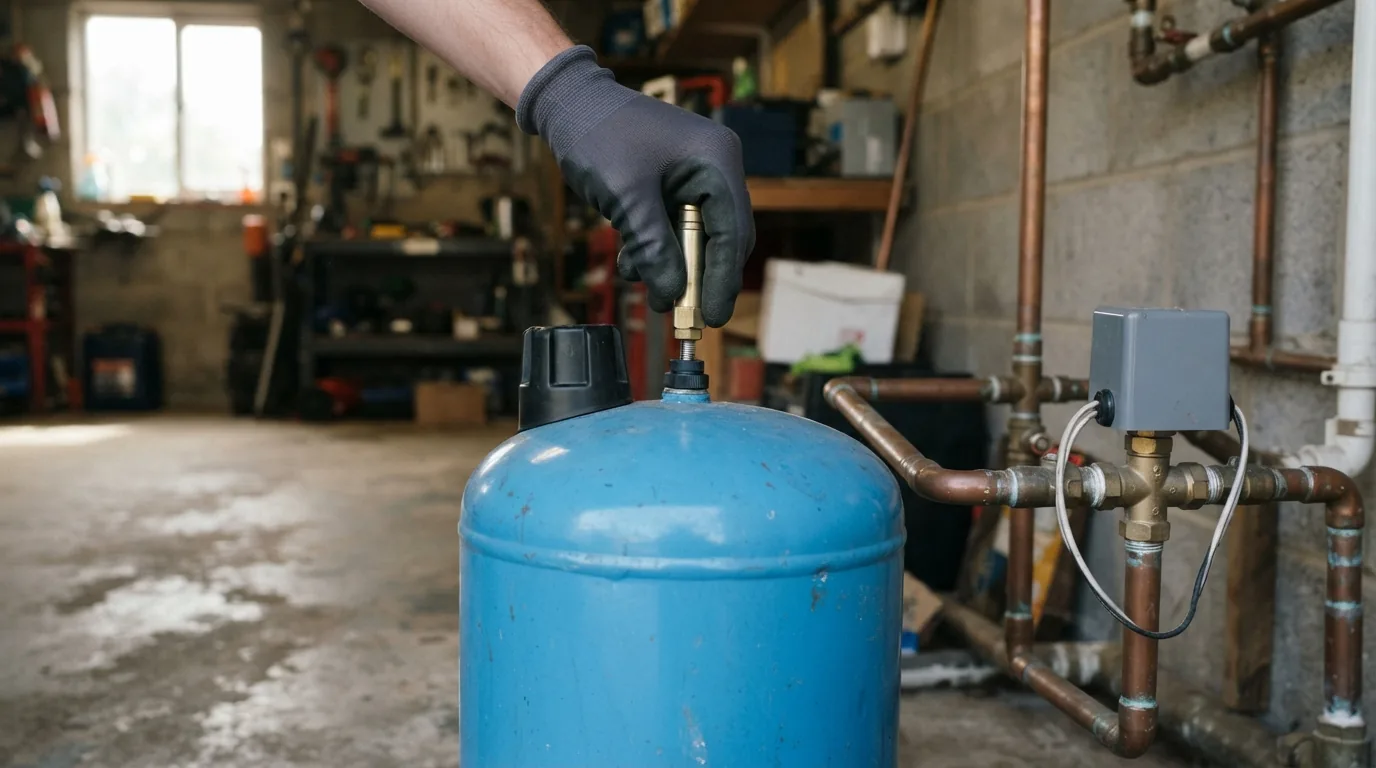
What controls the number of starts is the pressure tank. When it holds a proper air charge, the pump fills it and rests. When the charge is gone, there is no reserve, so the pump restarts every time anyone runs a tap.
This is the whole argument for maintenance. A pressure tank is an inexpensive part. The pump it protects is not. Checking the tank once a year is the difference between replacing a cheap component on your own schedule and replacing an expensive one on the system’s schedule.
If your pump is already clicking on and off every few seconds, the damage is happening now — see why your well pump keeps turning on and off.
What you can check yourself, in ten minutes
None of this needs tools or any electrical work. Do it once a year and you will catch most developing faults early.
1. Listen to a full pump cycle
Open a tap and let it run. Note how long the pump runs before it shuts off, and how long it rests before starting again. You are not looking for a specific number — you are establishing what normal sounds like on your system, so that next year you notice if it has changed.
If it starts and stops every few seconds, stop here and get it looked at.
2. Read the pressure gauge
Find the small round gauge on the pipework near the tank. Watch it through one cycle. It should climb steadily to a cut-out point, then fall steadily to a cut-in point — usually a 20 PSI gap, commonly 30/50 or 40/60. Write those two numbers down.
Rapid swinging, or a gap much smaller than 20 PSI, points at the tank.
3. Tap the pressure tank
Knock on the side of the tank, near the top and near the bottom. The top should sound hollow. The bottom should sound solid. If it sounds solid all the way up, the tank has filled with water and lost its air cushion. That is the single most common fault on any well system — see how to check and recharge a waterlogged tank.
4. Walk to the well head
Check the cap is on securely and not cracked. Look for standing water, soft ground, or soil that has washed away around the casing. Clear vegetation back from it. A well cap is the only thing between your drinking water and whatever is on the surface.
5. Look at your water, honestly
Fill a clear glass and hold it to the light. Note any cloudiness, particles, colour or smell — and whether anything has changed since last year. A sulphur smell, orange staining or fine sediment all mean something specific, and all are easier to address early.
What a professional check covers
The parts that need a meter, a gauge and the system depressurised. This is the annual service that actually protects the pump.
| Tank air charge | Measured with the system drained, and set to two PSI below the pump’s cut-in pressure. Guessing this is a common cause of repeat failures. |
| Switch calibration | Cut-in and cut-out checked against what the pump can actually deliver, and against the height it has to lift to. See pressure switch repair. |
| Electrical readings | Voltage and amp draw at the control box. A motor pulling more current than it should is telling you something months before it fails. |
| Flow and pressure | Readings at the well head and at the tap. The gap between them shows restrictions building up. See flow and pressure testing. |
| Wiring and connections | Corrosion at terminals, degraded insulation, and the condition of the buried run where it can be inspected. |
A maintenance calendar for Upstate wells
Piedmont conditions add a seasonal dimension that flat-aquifer regions do not have. This is roughly how the year runs here.
Spring — the full check
The best time for the annual service. The water table is usually at its highest after winter rain, so the system is under least stress and readings are cleanest. Deal with anything the check finds before summer demand arrives.
Early summer — before irrigation starts
If you run sprinklers, this is when to think about whether the tank can buffer the load. Irrigation is the hardest sustained draw on any residential system, and it exposes a marginal tank that indoor use never troubled. Very common around Simpsonville and the Golden Strip.
Late summer — watch the water level
After a dry spring, water levels in fractured-rock wells drop toward the pump intake. If you get air spitting from the taps or a sandy tinge, switch the pump off rather than waiting to see whether it clears. Running dry costs years. Properties on higher ground, such as Taylors and the foothills near Travelers Rest, notice this first.
Autumn — protect the exposed parts
Check insulation on any above-ground pipework and on the well house if you have one. A frozen discharge or supply line is an avoidable winter callout.
Winter — know where your breaker is
Label the pump breaker if it is not already labelled. When there is no water at ten at night, that is the first thing anyone will ask you to check. See what to check before you call.
Water testing, which is separate
Private wells are not regulated the way municipal supplies are. Nobody tests your water unless you arrange it.
The standard guidance for private wells is an annual test for bacteria and nitrates, plus a broader panel every few years or whenever taste, smell or appearance changes. It is also worth testing after any well work, after flooding, and before a baby joins the household.
Your county environmental health office can point you to certified laboratories. This is a water quality matter rather than a pump one — we service the equipment, not the chemistry — but it belongs on any honest maintenance list. More on how Upstate wells behave in the Upstate well owner’s guide.
What maintenance does not fix
Worth being straight about this, because maintenance is sometimes oversold.
- A well that was never sized for the house. If a two-bathroom farmhouse became a four-bathroom home, no amount of servicing changes the capacity. That needs the tank resized.
- Elevation losses. Every ten feet of rise costs about 4.3 PSI. A weak upstairs shower is physics, not neglect. See why your pressure is low.
- A genuinely worn-out pump. Servicing extends life; it does not extend it indefinitely. Expected ranges are covered in how long a well pump lasts.
- A dropping water table. Seasonal drawdown is a well characteristic, not a fault. Knowing your system’s normal behaviour is what stops it being mistaken for one.
What to remember
| 1 | The pressure tank is the whole job. Keep it charged and you protect the most expensive part of the system. |
| 2 | Knock on the tank once a year. Hollow at the top, solid at the bottom. Ten seconds, no tools. |
| 3 | Write down your cut-in and cut-out numbers. You cannot spot abnormal until you know what normal looks like. |
| 4 | Never let the pump run dry. Air from the taps in late summer means switch it off, not wait it out. |
| 5 | Annual servicing from about year seven. Before that, a homeowner check is usually enough. |
Frequently asked questions
How often should a well pump be serviced?
A homeowner check once a year is worth doing from the start. A professional service makes sense annually once the system passes about seven years, which is when tanks and switches typically begin to fail.
What does well pump maintenance involve?
Testing and correcting the pressure tank air charge, checking switch calibration, taking electrical readings at the control box, measuring flow and pressure, and inspecting wiring and the well head.
Can I maintain my well pump myself?
You can do the observational parts — listening to a cycle, reading the gauge, tapping the tank, checking the well cap. Setting the tank air charge requires the system depressurised, and switch work involves live wiring, so those are worth leaving alone.
How do I know if my pressure tank needs recharging?
Knock on the side. Hollow near the top and solid near the bottom is healthy. Solid all the way up means it has waterlogged. Rapid pump cycling is the other clear sign.
Does maintenance really extend the life of a well pump?
Substantially, because it reduces how often the pump starts. Starts, not running hours, are what wear out a motor. A correctly charged tank can be the difference between four years and twelve.
How often should well water be tested?
Annually for bacteria and nitrates, with a broader panel every few years or whenever taste, smell or appearance changes. Also after any well work or flooding.
Is a maintenance visit worth it if nothing seems wrong?
That is exactly when it is worth it. The faults that destroy pumps develop silently over months. By the time something seems wrong, the cheap window has usually closed.
Before it becomes an emergency
Book the annual check
We test the whole system across Upstate South Carolina — tank charge, switch settings, electrical readings, flow and pressure — and give you the numbers in writing so you know what normal looks like on your own well.
Open 7am–9pm, seven days · No call-out fee with a repair · Fixed price agreed in writing
Start with pressure tank service if the tank sounded solid, or see everything covered under well pump repair. Find your town on the areas we cover, or send us the details and tell us what your gauge is reading.