
In much of the rural Upstate, a private well is normal rather than unusual. Plenty of people move here from a city, sign for a house with a well, and only later realise that the water supply is now entirely their responsibility — no utility, no monthly bill, and nobody to call when the pressure drops.
That is fine. Wells are perfectly reliable when they are understood. The risk is not owning one; the risk is buying one blind.
What a standard home inspection actually covers
This surprises most buyers. A general home inspector will typically run a tap, confirm water flows, note that the property is on a well, and move on.
What they usually do not do:
- Test how much water the well can actually deliver over a sustained period
- Measure the pressure tank’s air charge or determine whether it has waterlogged
- Take electrical readings at the control box to see how hard the pump is working
- Establish the pump’s age or the well’s depth
- Test the water for bacteria, nitrates or anything else
None of that is a criticism of inspectors. Wells sit outside a general inspection’s scope, and doing it properly needs different equipment. But it does mean that “the inspection came back fine” and “the well is fine” are two different statements.
The four things that actually matter
1. The pump — how old, and how hard is it working
A submersible pump typically lasts eight to fifteen years, and a jet pump around ten. If the seller does not know the pump’s age, that itself is information: it usually means it has been there a while.
Age alone does not condemn a pump. What matters is how it is behaving. Electrical readings at the control box show whether the motor is drawing more current than it should, which is a fault developing months before it becomes a failure. More on the ranges in how long a well pump lasts.
2. The pressure tank — the cheap part that destroys the expensive one
This is the single most useful thing to check, and the easiest to miss.
A pressure tank that has lost its air charge makes the pump start hundreds of times a day instead of a handful. That is what ends pumps early. A waterlogged tank on a house you are buying means you are inheriting a pump that has already been damaged, even if it is still running today.
You can check it yourself during a viewing: knock on the side of the tank, top and bottom. Hollow at the top and solid at the bottom is healthy. Solid all the way up means waterlogged. See pressure tank service.
3. The yield — can the well keep up with your household
This is where Upstate geology matters. Piedmont wells draw from fractures in bedrock rather than from a sandy aquifer, so recovery rate varies enormously from property to property. Two wells a few hundred feet apart can perform completely differently.
A well that suited a retired couple may struggle with a family of five, two showers running and an irrigation system. That is not a fault — it is a capacity question, and it is answerable with a timed flow test before you commit. See flow and pressure testing.
4. The water itself
Private wells are not regulated the way municipal supplies are. Nobody has been testing this water unless the owner chose to.
At minimum, test for bacteria and nitrates before closing. A broader panel covering iron, manganese, hardness and pH is worth having too, because it tells you whether filtration will be needed — which is a real cost worth knowing about in advance rather than discovering in month two.
Questions to ask the seller
Most of these have no wrong answer. What matters is whether the answers exist at all.
| How old is the pump, and who fitted it? | An invoice is ideal. “It came with the house” is common and tells you it is old. |
| How deep is the well? | This decides what any future pump job costs. County records hold it for permitted wells. |
| Has it ever run low or run dry? | Particularly in late summer. A seasonal pattern is worth knowing before you buy, not after. |
| When was the water last tested? | “Never” is a very common answer. Get your own test either way. |
| Is there any filtration or a softener? | If there is, ask why it was fitted. That answer describes the water. |
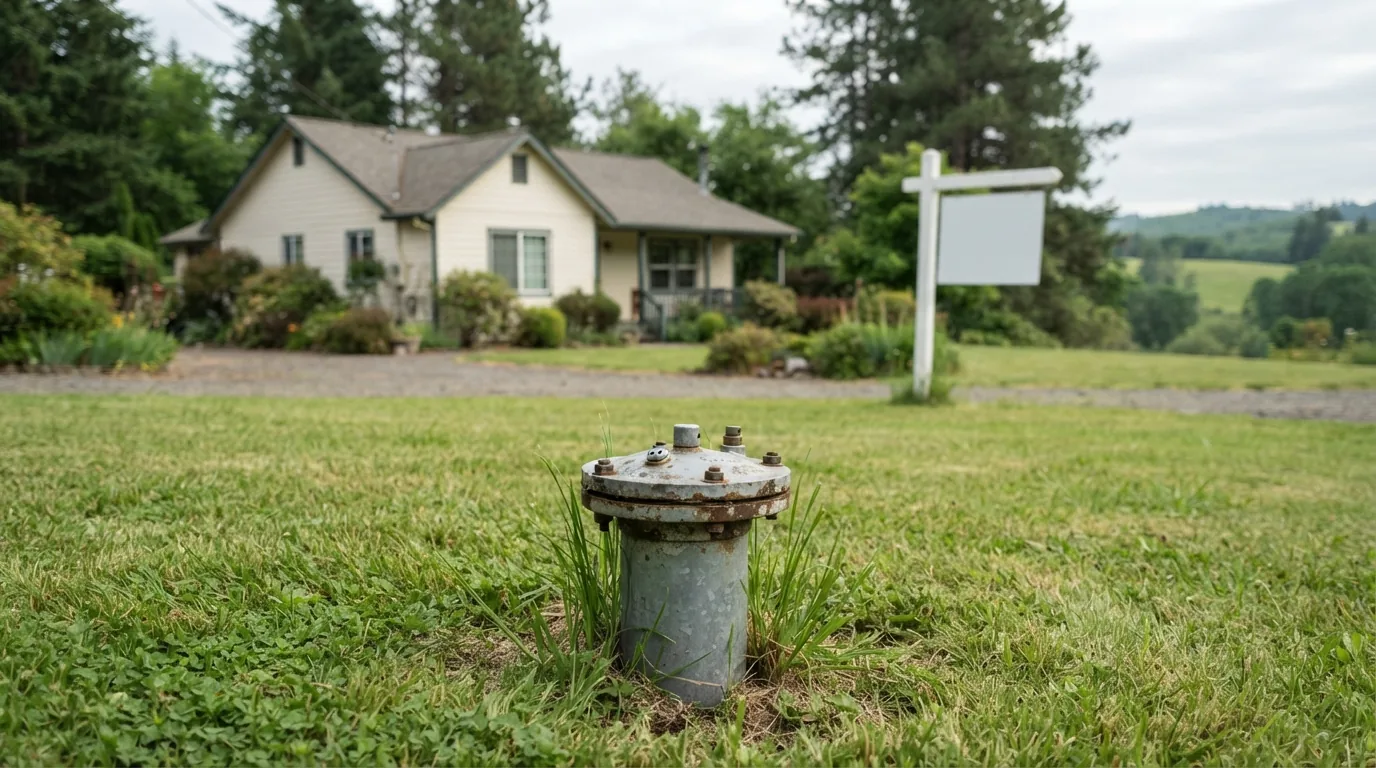
| Where exactly is the well head? | On many properties it has been landscaped over. Find it before you own it. |
Warning signs during a viewing
You can spot a surprising amount without any equipment. While you are walking round:
- Run two taps at once and see whether pressure holds. A collapse under simple simultaneous demand tells you the system is marginal.
- Listen for the pump cycling while a tap runs. Starting and stopping every few seconds is short cycling — explained in this article — and it means damage is already happening.
- Look for orange or brown staining in sinks, baths and toilet cisterns. That is iron, and it means filtration.
- Smell the water, especially the hot. A sulphur smell points at bacteria in the well.
- Check the well cap is intact and sits above ground level, with no standing water pooling around it.
- Look at the tank and switch. Heavy corrosion, damp patches or an obviously ancient control box are all worth pricing in.
Where the local details differ
Wells in the Upstate are not uniform, and what you should ask depends partly on where the property sits.
- Deeper wells south-west of Greenville. Around Anderson County, depth drives the cost of any future pump work more than anything else. Ask for the depth specifically.
- Newer houses on older wells. Around Greer and Simpsonville, farm-era wells often serve modern homes. Test under simultaneous demand rather than one tap.
- Higher ground. In Taylors and the foothills, elevation costs pressure upstairs. Run the highest fixture in the house during the viewing.
- Foothill properties. Near Travelers Rest, wells go deeper and there is no city main to fall back on. Access to the well head matters if a pump ever has to come out.
- Different county records. Easley and the surrounding area sit in Pickens County, so permits and drilling records are held separately from Greenville County.
- Working properties. Around Fountain Inn, a well may already be supplying a barn or livestock. Establish everything it feeds, not just the house.
Is any of this a reason not to buy?
Rarely. Most of what a proper well inspection turns up is fixable, and knowing about it before closing is exactly the point — it becomes a negotiation rather than a surprise.
Genuine concerns are narrower:
- A well that cannot supply the household even when everything is working correctly
- Persistent bacterial contamination that repeat treatment has not resolved
- A well head sited where surface water pools, or an unpermitted well with no records at all
- A seller unwilling to allow any testing before closing
That last one is the real red flag. Everything else is a number you can plan around.
What to remember
| 1 | A home inspection is not a well inspection. Water coming out of a tap proves very little. |
| 2 | Knock on the pressure tank during the viewing. Solid all the way up means you are inheriting a pump that has been overworked. |
| 3 | Test yield under real demand. One tap running proves nothing about a family of five. |
| 4 | Test the water yourself. Bacteria and nitrates at minimum. Nobody else has been doing it. |
| 5 | Most findings are negotiable, not disqualifying. The problem is not knowing, not the well itself. |
Frequently asked questions
Should I get a well inspection when buying a house?
Yes. A standard home inspection confirms water flows but does not test yield, tank condition, electrical draw or water quality. A separate well check covers all four, and it is inexpensive relative to what it can find.
What does a well inspection include?
A timed flow test to establish yield, pressure tank air charge, switch calibration, electrical readings at the control box, an inspection of the well head and casing, and water sampling where requested.
How long does a pre-purchase well check take?
Usually an hour or so on site, plus laboratory turnaround if water samples are taken. Worth arranging early in the inspection period so results arrive before any deadline.
Who pays for a well inspection, the buyer or the seller?
Normally the buyer, as part of due diligence. Findings are then commonly used in negotiation, in the same way as any other inspection result.
Can I test the water myself?
Home kits give a rough indication, but for a purchase decision use a certified laboratory. Your county environmental health office can point you to one.
What if the seller does not know anything about the well?
Extremely common, and not in itself a problem. County permit records may hold the depth and construction details, and testing establishes the rest regardless of what anyone remembers.
Is a house with a well harder to sell later?
Not in this area, where wells are normal. A documented service history and recent water test actually make it easier, because the next buyer is not being asked to guess.
Before you close
Find out what you are buying
We inspect wells for buyers across Upstate South Carolina — yield, tank condition, switch settings, electrical draw and well head — and give you the findings in writing, in time for your inspection period.
Open 7am–9pm, seven days · Findings in writing · Fixed price agreed up front
Once the house is yours, the annual maintenance check is what keeps it trouble-free. For how wells behave in this part of the state, see the Upstate well owner’s guide. Find your town on the areas we cover, or send us the property details.