
No water at all is one of the few household problems with no workaround. You cannot boil a kettle, flush properly, or shower. On a private well there is no utility to ring and no neighbour on the same supply to compare notes with.
The instinct is to call someone immediately, and if you have no water that is the right instinct. But five minutes of checking first will either save you a callout entirely, or tell whoever comes out exactly where to start — which usually means the job finishes on the first visit.
Here is what to look at, in the order that matters.
1. Check the breaker — and look at it properly
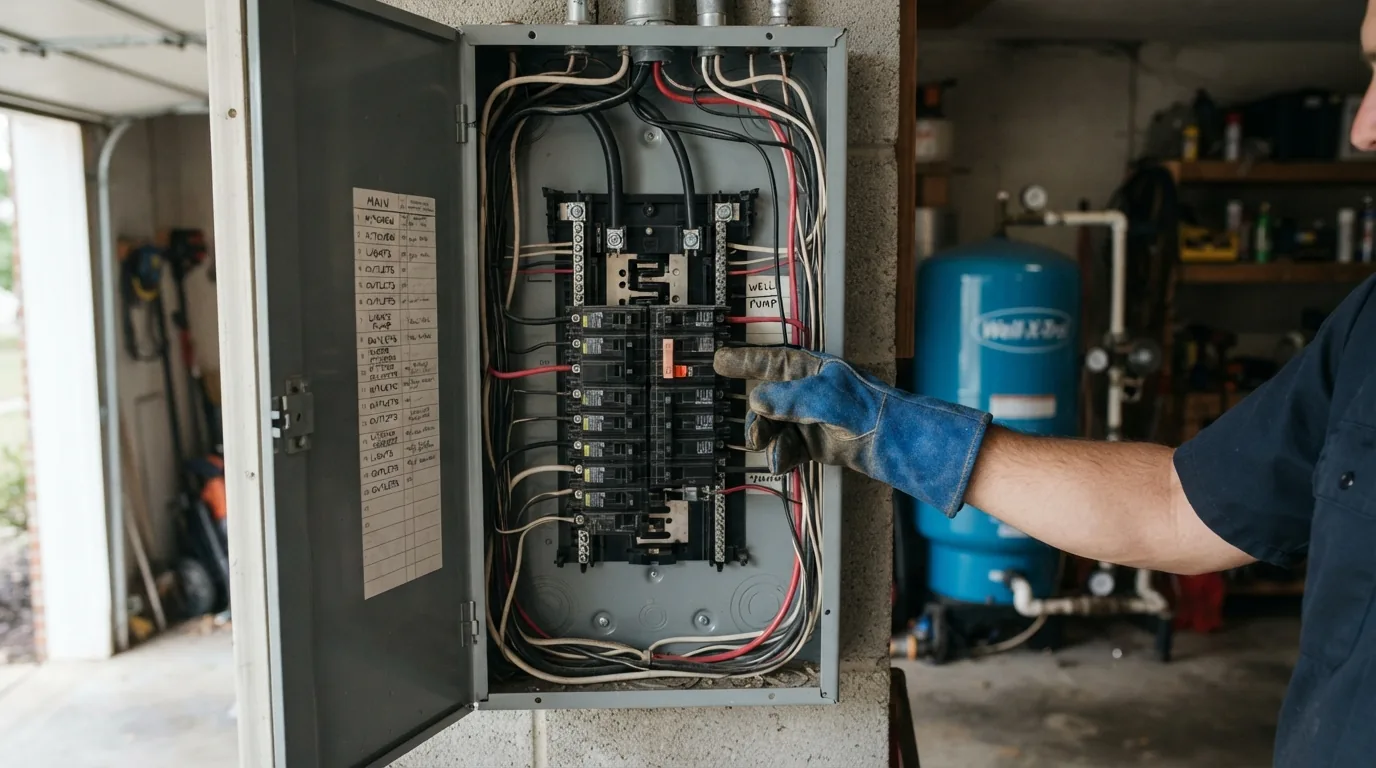
Your well pump runs on its own circuit, usually a double-pole breaker in the main panel. On a lot of properties it is in the garage or a utility room rather than with the household breakers, which is why people miss it.
A tripped breaker often does not look obviously off. It sits slightly out of line with the others rather than fully down. Look along the row and find the one that is not quite aligned.
If it has tripped, reset it once. Push it fully off, then fully on. If water comes back and stays back, you may have had a one-off surge and nothing more.
If it trips again, stop. A breaker that keeps tripping is doing its job — it is protecting you from a real fault, usually a failing capacitor, a shorted motor winding, or damaged underground cable. Each reset pushes current through that fault and makes the damage worse. Leave it off and call someone.
2. Is it the whole house, or one tap?
This single question separates a well problem from a plumbing problem, and it takes thirty seconds to answer.
Try the kitchen, a bathroom, and an outside tap if you have one.
- Nothing anywhere — the fault is at the well, the pump, or the electrical supply to it.
- Weak or no water at one fixture only — that is almost certainly a blocked aerator, a failed valve, or a plumbing fault in the house. Nothing to do with the pump. Our residential plumbing page covers that side.
- Weak everywhere but not completely dry — that points at pressure rather than power. Usually the switch or the pressure tank, and worth reading about flow and pressure testing.
On a rural property, check the outbuildings too. If the house is fine and the barn is dry, the fault is out on the buried line rather than at the pump — a pattern we see constantly on working properties around Fountain Inn.
3. Look at the pressure gauge
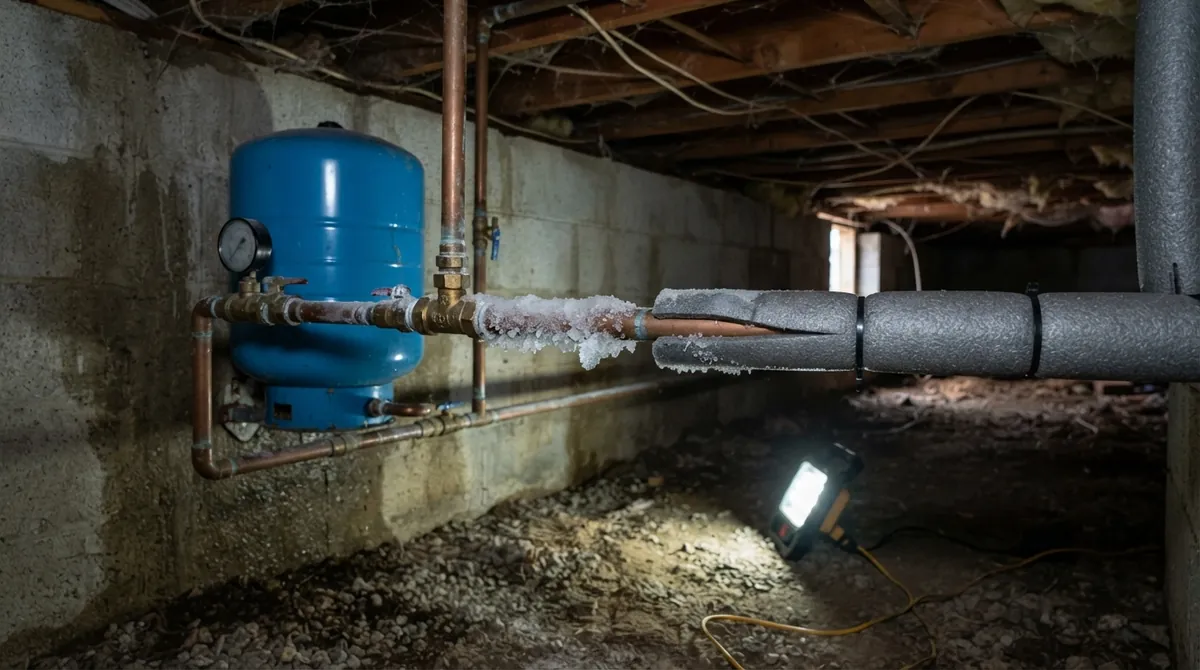
Find your pressure tank — usually a blue or grey cylinder in the garage, basement, crawl space or a well house. There will be a small round gauge on the pipework near it.
What it reads tells you a great deal:
- Zero — there is no pressure in the system at all. The pump is not delivering, which points at power, the pump itself, or a system that has lost prime.
- Sitting at 20 to 30 PSI and not moving — the pump should have kicked in by now and has not. Often the pressure switch.
- Normal, around 40 to 60 PSI, but no water at the taps — the well side is fine. The problem is between the tank and the house.
Write the number down. It is the single most useful thing you can tell us on the phone.
4. Listen at the pressure switch
The pressure switch is the small grey or black box mounted on the pipework near the tank, with a thin tube connecting it. It is the component that tells the pump when to start.
Stand near it with a tap open and listen.
- A click, then silence — the switch is calling for the pump but nothing is happening. Points at the pump, the control box or the wiring.
- A hum with no water — the motor is getting power but not turning properly. Often a failed capacitor.
- Rapid clicking on and off — that is short cycling, and it is a different fault entirely. We covered it in detail in why your well pump keeps turning on and off.
- Nothing at all — no power reaching the switch. Back to the breaker.
You do not need to diagnose it from this. You just need to be able to describe it, because it narrows the cause enormously before anyone arrives.
What not to do
Do not keep resetting the breaker
Worth repeating, because it is the most expensive mistake people make while waiting for help. A breaker that trips repeatedly is protecting a fault. Each reset sends another surge through it. We have attended jobs that would have been a capacitor replacement and became a pump replacement because the breaker was cycled twenty times overnight.
Do not open the well cap
There is nothing serviceable up there for a homeowner, and an open well casing is a contamination risk. It is also live electrically on most systems.
Do not let the pump run dry
If you are getting air spitting from the taps, or the water has gone sandy, switch the pump off. That usually means the water level has dropped near the pump intake — common during a dry summer, especially on higher ground like Travelers Rest and the northern foothills. The pump is probably fine right now. Running it on air will finish it. If the pump is clearly running but nothing is reaching the taps at all, that is a separate fault with its own causes — see well pump running but no water.
Do not accept a quote from anyone who has not tested the system
If someone arrives, looks at the pump and quotes for a replacement without testing the switch, the tank charge, the control box and the wiring, get a second opinion. Most no-water callouts turn out to be a surface fault, and those cost a fraction of a new pump.
When to call straight away
Skip the checks and call if any of these apply:
- The breaker trips again immediately after a reset
- There is a burning smell near the control box or pressure switch
- Water is visibly leaking or pooling around the well head or tank
- You have livestock or animals depending on the supply
- You are simply not comfortable being near the electrics — which is a perfectly reasonable position
What to remember
| 1 | Check the breaker first. Reset it once. If it holds, you may be done. If it trips again, leave it off. |
| 2 | Whole house or one tap? One tap is a plumbing fault. Everything dry is a well fault. |
| 3 | Read the pressure gauge and write the number down. It is the most useful single detail you can give us. |
| 4 | Listen at the pressure switch. Click, hum, rapid clicking or silence — each points somewhere different. |
| 5 | Most no-water calls are not a dead pump. A switch, capacitor, control box or wiring fault produces identical symptoms and costs far less. |
Frequently asked questions
My well pump is not working but the breaker has not tripped. What now?
That points at the pump side rather than the supply — a failed capacitor, a control box fault, or a pump that has reached the end. Listen at the pressure switch: a click with no response, or a hum with no water, both narrow it down. It still needs testing rather than guessing.
How do I know if it is the pump or the pressure tank?
The gauge tells you most of it. No pressure at all points at the pump or its power supply. Pressure that builds and drops rapidly points at the tank. Normal pressure with no water at the taps points at the plumbing between the two.
Can I fix a well pump myself?
You can safely reset a breaker once and check the gauge. Beyond that, well systems combine mains electricity with water, often at 240 volts, and the pump itself may sit hundreds of feet down. Diagnosis needs meter readings rather than guesswork.
Why does my pump hum but produce no water?
Usually a failed start capacitor. The motor is receiving power but cannot get turning. It can also mean a seized pump or a system that has lost prime. Switch it off rather than leaving it humming, as it will overheat.
How quickly can someone come out?
We treat total loss of water as urgent and run callouts seven days a week, 7am to 9pm, across Upstate South Carolina. Most of our area is within thirty minutes — see the areas we cover.
Will I definitely need a new pump?
Usually not. Most no-water callouts turn out to be a pressure switch, capacitor, control box or wiring fault, all of which are repairs. See what a proper diagnosis covers before anyone talks about replacement.
What should I tell you when I call?
Your town, what the gauge reads, whether the breaker has tripped, and what you heard at the pressure switch. Those four details often narrow the cause before we set off, which means the van arrives with the right part.
No water right now?
Tell us what you found
We run emergency callouts across Upstate South Carolina, seven days a week. Tell us the gauge reading and what the breaker is doing, and we will usually know what we are dealing with before we arrive.
Open 7am–9pm, seven days · No call-out fee with a repair · Fixed price agreed in writing
If the pressure gauge pointed at the tank, read more about pressure tank service. If the switch was clicking with no response, see pressure switch and control box repair. Not sure who to call? This is what to ask before you book anyone. Or use our contact form and tell us what you found.