
Well Pump Repair in Anderson, SC
No water, weak pressure, or a pump that won’t shut off? We service private wells across Anderson County — testing the whole system, identifying the actual fault, and quoting it in writing before we start.
- Same-day across the county
- Open 7am–9pm, seven days
- Licensed & insured
Get a Free Quote
Rather not call? Send this and we’ll get back to you fast.
What's Happening at Your Tap Right Now?
Every well problem looks like “the pump is broken” from inside the house. On a 300-foot well that assumption is expensive, because the pump is the one part that costs real money to reach. Find your symptom below — most of these are surface faults.
No water at all
On a deep well the cause is usually electrical rather than mechanical — a tripped breaker, a burnt capacitor or a failed control box at the surface. All of that is testable without pulling anything. What you heard before it stopped tells us a lot.
Water pressure keeps dropping
Deep systems cycle harder than shallow ones, so the switch contacts here wear out years before the pump does. Nine times out of ten this is a surface part, not the motor 300 feet down.
Pump runs constantly or won’t shut off
The pump never reaches cut-out. On rural properties with long buried runs to barns or outbuildings, a leak somewhere on that line is a common culprit — and the pump burns power continuously while it hunts.
Pump clicks on and off every few seconds
Short cycling, and it kills motors fast. Iron and sediment in Anderson groundwater shorten bladder life, so tanks here waterlog sooner than the manufacturer’s figures suggest.
Air spitting or sandy water from the taps
Classic Anderson County late-summer callout. The water table has dropped toward the pump intake after a dry spell. The pump is usually fine — but running it on air will finish it, so switch off and call.
Breaker keeps tripping
On deep wells the buried cable run is long, and damaged cable is a real possibility alongside a failing capacitor or shorted winding. Leave the breaker off — each reset drives more current through the fault.
What We See on Anderson County Wells
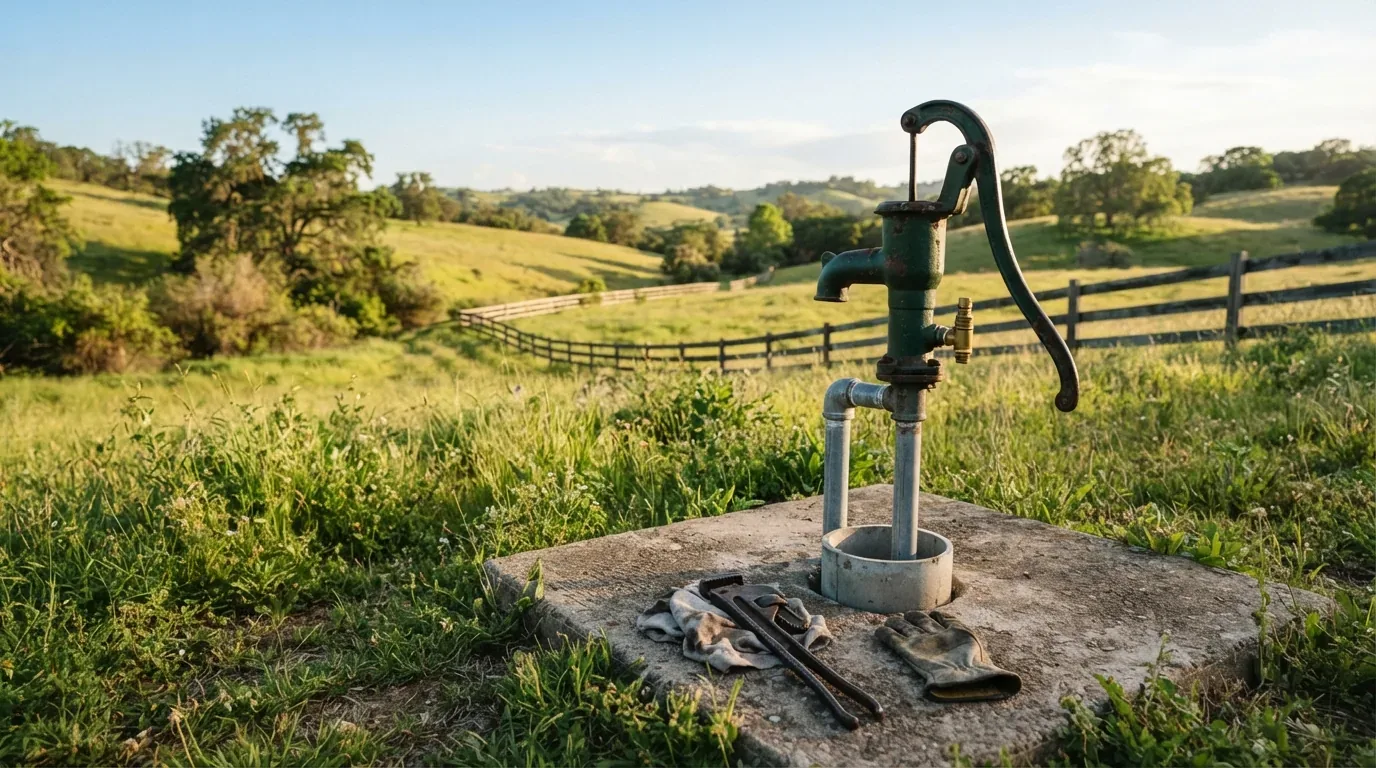
Anderson sits on the Piedmont’s weathered granite and gneiss, so most private wells here are drilled rather than dug — typically 150 to 400 feet, with a submersible pump set well below the water line.
That geology shapes what actually fails, and it is why a technician who works these wells every week reaches for different tests than someone who mostly does city plumbing:
- Pressure switches wear out first. Deep systems cycle harder, so switch contacts pit and burn sooner than on shallow wells.
- Dry spells drop the water table. Late-summer callouts here are frequently air in the lines, not a broken pump.
- Older lake-area properties often still run jet pumps installed decades ago — working, but well past service life.
- Iron and sediment are common in this groundwater, and they quietly wear tank bladders, switch ports and filter cartridges.
- Pulling a deep submersible takes equipment. Which is exactly why we rule out the cheap faults before assuming the pump is finished.
Well Pump Services in Anderson
Everything below is work we carry out across Anderson County, on submersible and jet systems of any age or brand — including installs done by other companies. Follow any service for the full detail.
Well Pump Repair
Surface testing first on every job. On wells this deep, ruling out the switch and control box before pulling anything is what keeps the bill down.
Well Pump Replacement
When a deep-well pump is genuinely finished, horsepower gets matched to the depth and the household — undersize it here and it never keeps up.
Pressure Tank Service
Bladders wear faster where the groundwater carries iron and sediment, which is most of this county. Air charge tested on every visit.
Pressure Switch & Controls
Deep systems cycle harder, so contacts pit and burn out sooner here than on shallow wells. Cheapest part on the system, and the most frequent failure.
Emergency Repair
Late callouts for homes with no water, seven days a week. We narrow the fault on the phone so the van arrives with the part.
Flow & Pressure Testing
Readings at the well head and at the tap. Essential during a dry spell, when low flow is the water table rather than the pump.
No Water Tonight? Don't Wait Until Monday
No water means no drinking, no showers and no working toilets — that isn’t something that waits. Before we arrive, stop switching the breaker on and off. Repeatedly restarting a struggling motor is the fastest way to destroy it completely.
What Happens When You Call Us
No guesswork, and nothing added to the bill after the fact. The order is the same on every job, emergency or not.
STEP 01
Tell us the symptom
Anderson is a thirty-five minute run, so the phone call matters. Tell us what you heard — clicking, humming or silence — and the van loads the right parts before setting off.
STEP 02
Test the whole system
Electrical readings at the control box, pressure cut-in and cut-out at the switch, air charge at the tank. On a deep well, all of that happens before anyone discusses pulling the pump.
STEP 03
Fixed price, then repair
Written price, agreed before work starts. Surface repairs almost always finish the same visit; a deep pull is quoted separately so there are no surprises.
What Changes the Cost of a Well Pump Repair
An honest number isn’t possible until someone has tested the system. But on Anderson County wells the price is driven by one thing more than any other: whether the fault is above the well cap or below it.
Surface fault or downhole
Everything above the well cap — switch, capacitor, control box, wiring — is a small job. Everything below it is not. That single distinction sets most of the price.
Well depth
On Anderson County wells running 150 to 400 feet, anything that involves pulling the drop pipe takes considerably longer than on a shallow system.
Jet or submersible
The older jet systems around the lake sit at the surface and are quick to work on. A submersible 300 feet down is a different job entirely.
Condition of the drop pipe
Once a pump is out of a deep well, corroded pipe or perished wire is often visible — and replacing it while everything is up costs far less than a second pull later.
How far out you are
Anderson County covers a lot of ground. A callout to Townville or Starr is a longer run than one into the city, and an after-hours job costs more than a booked slot either way.
Access to the well head
Overgrown, buried or awkwardly placed well heads add time before any actual repair work can begin.
What we won’t do: quote a price over the phone without seeing the system, or add parts to the bill after the work is approved. If a company gives you a firm number before testing anything, ask what happens when the fault turns out to be something else.
We'd Rather Fix It Than Sell You a Pump
Replacing a pump that was never broken is the most expensive mistake in this trade. On a 300-foot Anderson County well it’s also one of the costliest, because pulling a submersible needs equipment and hours — and if the fault was a $40 switch, you paid for all of that unnecessarily.
So we work in the order that costs you least:
- Cheapest faults ruled out first. Switch, capacitor, control box and wiring — all testable at the surface, before anyone touches the well cap.
- You see the readings. Voltage, amperage, pressure cut-in and cut-out — written down, so the diagnosis isn't just our word for it.
- Depth priced honestly. If the pump genuinely has to come out of a deep Anderson well, you know that number before we start, not after.
- Seasonal faults called correctly. Air in the lines during a dry August is not a dead pump, and we won't sell you one.
- Re-tested before we leave. Flow and pressure at the tap, plus the tank charge checked so the same fault doesn't return.
Areas We Reach Around Anderson
We cover Anderson city and the surrounding county, including the lake communities where many of the older jet pump systems still are. Not sure you’re in range? Call and tell us your town — we’ll say straight away rather than waste your time.
- Belton
- Williamston
- Pendleton
- Powdersville
- Piedmont
- Honea Path
- Iva
- Starr
- Townville
- Pelzer
- Lake Hartwell area
Typical Anderson County Well Profile
| Characteristic | What it usually means here |
|---|---|
| Typical depth | 150–400 ft drilled wells through weathered Piedmont rock |
| Most common system | Submersible pump, ½ to 1 HP, with a bladder pressure tank |
| Frequent complaint | Pressure dropping off — most often the switch or a waterlogged tank |
| Seasonal pattern | Air and sputtering taps in late summer as the water table drops |
| Water quality | Iron and sediment common, which wears switches, bladders and filters |
| Older properties | Jet pump systems still in service around the lake communities |
Not sure it’s the pump? Most of the callouts we take turn out to be a switch, pressure tank or wiring fault rather than a dead pump. We test the whole system before quoting, so you don’t end up paying for a replacement you never needed.
Anderson Well Pump FAQs
Yes — Anderson city, Belton, Williamston, Pendleton, Powdersville, Honea Path, Iva, Starr, Townville and the Lake Hartwell communities. If you’re not sure you’re in range, call and tell us your town.
Most of the county is roughly a thirty to forty minute drive, so same-day appointments are normal. For homes with no water at all we run emergency callouts seven days a week, 7am to 9pm.
The honest answer is that depth decides it. A pressure switch, capacitor or control box is a modest job because it’s all at the surface. Pulling a submersible from 300 feet is a different scale of work entirely. We test first, establish which side of the well cap the fault is on, then give you a fixed price in writing.
If nobody tested the switch, tank and wiring at the surface first, then yes. On a deep Anderson well the pump is the most expensive thing to reach, so assuming it’s the pump is an expensive assumption. See well pump replacement for when a new unit genuinely is the answer.
Most drilled wells in Anderson County run between 150 and 400 feet through weathered Piedmont rock. That depth means a submersible pump, and pulling one takes equipment — which is exactly why we rule out the cheaper faults first.
Often not. Air in the lines during a dry spell usually means the water table has dropped near the pump intake. It still needs checking, because running a pump dry does real damage, but it’s a different problem from a failed pump.
Iron and sediment are common in Anderson County groundwater, and both wear bladders faster than clean water does. If your pump is switching on and off every few seconds, that’s short cycling from a waterlogged tank — and every cycle wears the motor. See pressure tank service.
No. On a deep well the buried cable run between the control box and the pump is long, and damaged cable is a genuine possibility alongside a failing capacitor or shorted winding. Each reset drives more current through whatever is faulty. Leave it off and call.
Yes. Plenty of the older properties around Lake Hartwell still run jet pumps installed decades ago, and we service those as readily as modern submersibles — any age, any brand, including installs done by other companies.
Usually not, and on a deep well it’s an expensive way to find that out. Pressure range is set by the switch, not by pump size. Fit a bigger pump to a system with a failing tank or a restriction and it simply works harder and fails sooner.
No call-out fee anywhere in the county when you go ahead with the repair. Anderson County covers a lot of ground, but the price you’re quoted in writing is the price — nothing added for travel afterwards.
Eight to fifteen years for a correctly sized unit. Two things cut that short here: short cycling from a tank that has lost its charge, and sediment working through the pump during dry spells when the water level drops. We check both on every visit.
No water in Anderson?
Tell us what the pump is doing and we’ll narrow it down on the phone, so the van arrives with the right part. Same-day across Anderson County.