
Low water pressure is the most common complaint we get, and the most commonly misdiagnosed. It is also the fault most likely to end with a homeowner buying a pump they never needed.
That happens because “low pressure” is a symptom with about a dozen possible causes, and the pump is only one of them. So before looking at causes, it is worth separating two things that get confused constantly.
Pressure and flow are not the same thing
This distinction does more diagnostic work than anything else in this article.
- Pressure is the force pushing water out. Measured in PSI. It is set by your pressure switch, not by the pump.
- Flow is how much water arrives. Measured in gallons per minute. It is limited by pipe size, restrictions and the well’s output.
A shower that dribbles can be either. If pressure is fine at the gauge but the shower is weak, you have a flow restriction — a blocked aerator, a partly closed valve, scaled pipework. If pressure itself is low at the gauge, the problem is at the well or the controls.
Most people report both as “low pressure”, which is why testing at two points matters. That is exactly what flow and pressure testing is for: readings at the well head and at the tap, so the gap between them shows where the fault lives.
Question 1: Where is the pressure low?
The answer to this alone rules out most of the possible causes.
One fixture only
Not a well problem. A blocked aerator, a failing cartridge, a partly closed shut-off valve, or a restriction in that branch of pipework. Unscrew the aerator on the tap and check it — mineral debris in there is extremely common on well water. This sits on the house plumbing side rather than the well side.
Everywhere in the house, all the time
Now it is the well side. Pressure switch setting, waterlogged tank, clogged sediment filter, or a pump that has genuinely lost output.
Only upstairs, or only at the far end of the house
This is elevation, and it deserves its own section below — because it is the cause almost nobody explains properly.
Only when more than one thing is running
Your system cannot keep up with simultaneous demand. It is usually an undersized pressure tank rather than an undersized pump. Common on properties where a larger house was built on an existing well — something we see constantly on Simpsonville and Greer properties, where a well drilled for a two-bathroom farmhouse now serves four bathrooms and an irrigation system.
Only when the sprinklers or a hose is on
Irrigation is the hardest sustained draw on the whole property. It exposes a marginal tank or switch that indoor use never troubled.
Question 2: When did it change?
This is how a technician thinks, and it splits the causes cleanly in two.
Sudden change — overnight, or within a day or two. Something failed. A pressure switch, a bladder rupturing in the tank, a capacitor, or a leak opening up on a line. Components fail suddenly; wear does not.
Gradual decline — over months or a season. Something is wearing or accumulating. Scale narrowing pipework, a filter slowly clogging, an impeller wearing, or a water table dropping through a dry summer.
People often cannot answer this at first, then realise they can. “It has been getting worse since spring” and “it was fine yesterday” lead to completely different places.
Question 3: What does the gauge say?
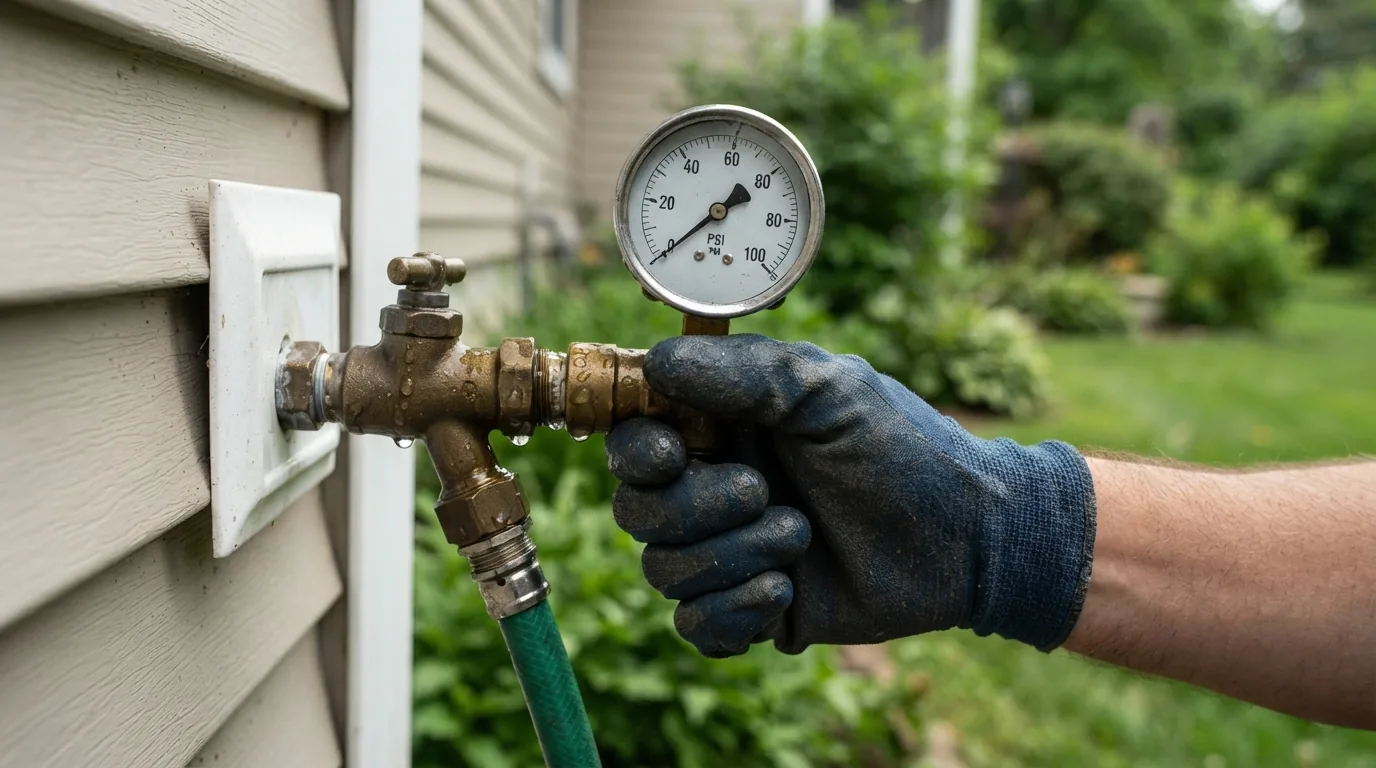
Find the pressure gauge on the pipework near your pressure tank. This one reading tells you more than any amount of guessing.
- Cycling between roughly 30 and 50 PSI, or 40 and 60 — the controls are working. Your problem is downstream: filters, pipework, or elevation.
- Sitting low and barely moving — the pressure switch is set low, or the pump cannot build pressure.
- Swinging up and down rapidly while a tap runs — a waterlogged pressure tank. There is no air cushion left to hold pressure steady.
- Climbs slowly and never reaches cut-out — the pump is struggling, or there is a leak on the supply line bleeding pressure away.
- Drops sharply the moment a tap opens, then recovers — the tank has almost no usable reserve.
Worth buying: a screw-on pressure gauge for an outside spigot costs very little and lets you see what the taps are actually getting, rather than what the tank is producing. The difference between those two numbers is often the whole diagnosis.
The elevation cause nobody explains
Water has weight, and pushing it upward costs pressure. The figure is fixed by physics: roughly 0.43 PSI for every foot of rise.
Which means:
- 10 feet of rise — about 4.3 PSI lost
- A second-floor shower, 20 feet above the tank — about 8.6 PSI lost
- A house set 30 feet above the well head — about 13 PSI gone before the water reaches the building
So a system reading a healthy 45 PSI at the tank can be delivering under 32 PSI at an upstairs shower — and a house on a slope can be worse again. Nothing is broken. The system was simply never adjusted for the height it has to lift against.
This is the single most common explanation for “great pressure downstairs, useless upstairs”, and it is why the fault shows up so often on the higher ground around Taylors and in the foothills near Travelers Rest. On flat suburban lots it barely registers. On a sloped Upstate property it decides how the shower feels.
The cheapest fix most people never hear about
Pressure switches come pre-set from the factory, usually at 30/50 — the pump starts at 30 PSI and stops at 50. That is a conservative default chosen to suit any installation.
Plenty of systems will run comfortably at 40/60 instead. That is 10 PSI more at every fixture in the house, and it costs nothing except the visit — no parts at all.
It is not always possible. Three things have to be true:
- The pump has to be capable of reaching the higher cut-out pressure
- The pressure tank’s air charge has to be adjusted to match, or it will waterlog
- The pipework and fittings have to be in good enough condition to take it
Which is why it needs testing rather than turning the screw and hoping. But when those conditions are met, this single adjustment solves more upstairs pressure complaints than any part we fit. See pressure switch and control box repair for how the settings work.
Why a bigger pump is almost never the answer
This is worth being blunt about, because it is the most expensive mistake available to a well owner.
The pressure at your taps is set by the pressure switch, not by the pump’s horsepower. A bigger pump fitted to a system whose switch cuts out at 50 PSI still delivers 50 PSI. It just gets there faster, draws more power doing it, and wears out sooner.
Worse, if the underlying cause was a restriction or a failing tank, the larger pump now works against that same restriction with more force. We have replaced pumps that were fitted eighteen months earlier to “fix the pressure” and failed early doing exactly that.
If you have been quoted a larger pump for a pressure complaint and nobody tested the switch settings, the tank charge and the flow at the fixtures first, that quote is worth a second opinion. Replacement is occasionally the right answer — but it should be the conclusion of a diagnosis, not the opening offer.
Causes we find most often, in order
Across the callouts we attend for low pressure, this is roughly how the causes rank:
- Pressure switch set low, or out of calibration — no parts needed in many cases
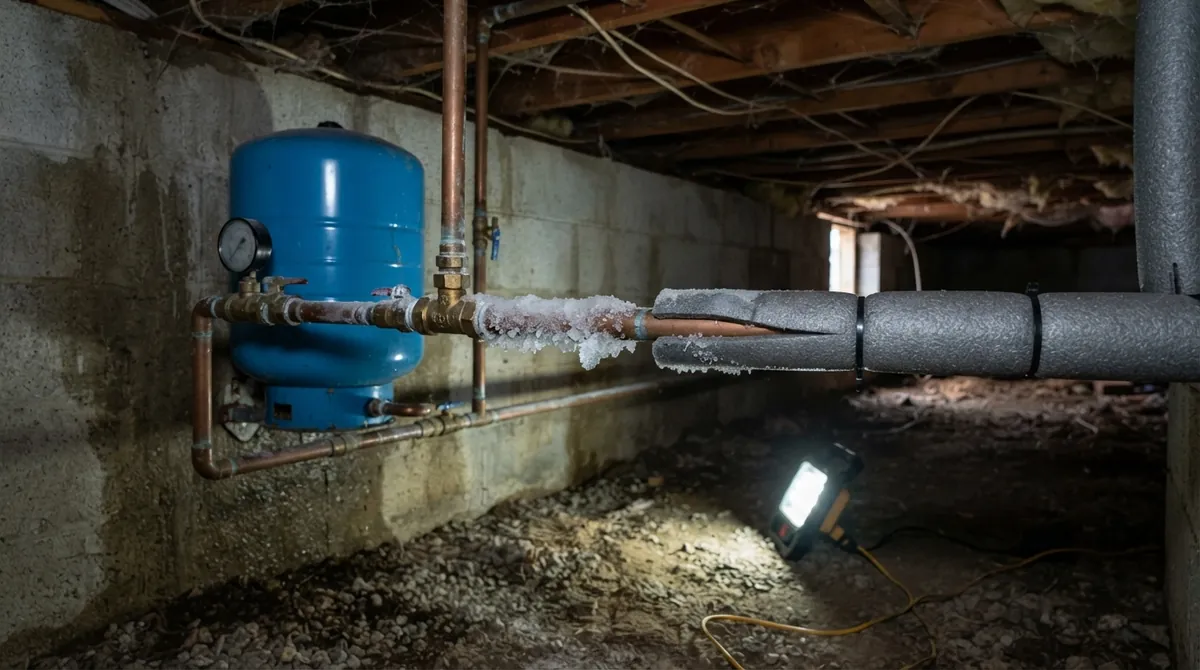
- Waterlogged pressure tank — pressure will not hold steady
- Clogged sediment filter — good pressure at the tank, poor pressure indoors
- Elevation never accounted for — upstairs weak, downstairs fine
- Undersized tank for the household — fine alone, collapses under simultaneous demand
- Scale or corrosion in the pipework — gradual decline over years
- Leak on the supply line — pump runs constantly and still cannot hold pressure
- Falling water table or clogged well screen — flow drops the longer a tap runs
- Genuine pump wear — healthy controls, healthy tank, output simply gone
Only the last of those is a pump problem. That ordering is the whole reason we test before quoting anything.
What to remember
| 1 | One weak fixture is a plumbing fault, not a well fault. Check the aerator before anything else. |
| 2 | Sudden means a part failed. Gradual means something is wearing. The timing splits the causes in half. |
| 3 | Every 10 feet of rise costs about 4.3 PSI. Weak upstairs and fine downstairs is usually elevation, not failure. |
| 4 | Moving from 30/50 to 40/60 adds 10 PSI everywhere — where the pump and tank allow it, and it needs no parts at all. |
| 5 | A bigger pump does not raise pressure. The switch sets the pressure. Horsepower only changes how fast it gets there. |
Frequently asked questions
What is normal water pressure for a private well?
Most systems run between 40 and 60 PSI, set by the pressure switch. What matters more than the number is whether it holds steady while water is running rather than surging and dropping.
Why is my well water pressure low all of a sudden?
A sudden change points at a failure rather than wear — most often a pressure switch, a ruptured tank bladder, a capacitor, or a leak that has opened up on a line. Check the gauge first: if it is swinging rapidly, the tank is the likely culprit.
Why is my water pressure low upstairs but fine downstairs?
Elevation. Every foot of rise costs about 0.43 PSI, so a second-floor fixture sits roughly 8 to 9 PSI below what the tank is producing. Adjusting the switch settings, where the pump allows it, is usually the fix.
Can I adjust my own pressure switch?
The adjustment screw is accessible, but the switch sits in a live circuit and the tank’s air charge has to be reset to match afterwards. Raising cut-out beyond what the pump can reach means it never shuts off, which does real damage.
Will a bigger pump fix low water pressure?
Almost never. Pressure is set by the switch, not the pump. A larger pump on the same settings delivers the same PSI while drawing more power and wearing out sooner.
Why does my pressure drop when two showers are running?
The system cannot buffer simultaneous demand, which is usually an undersized pressure tank rather than an undersized pump. Correct tank sizing fixes it, and costs a fraction of a pump.
My pressure has been slowly getting worse for months. What is that?
Gradual decline suggests accumulation or wear — a clogging filter, scale narrowing the pipework, a worn impeller, or a water table that has dropped. A timed flow test separates those, because each behaves differently under a sustained draw.
Before anyone sells you a pump
Let us measure it first
We take readings at the well head and at the tap across Upstate South Carolina, then tell you what the numbers actually mean. If the fix is a setting rather than a part, that is what we will quote.
Open 7am–9pm, seven days · No call-out fee with a repair · Fixed price agreed in writing
If the gauge was swinging, start with pressure tank service. If the pump also runs constantly, read why a pump keeps turning on and off. If it has stopped altogether, see what to check first. Not sure who to call? This is what to ask before you book anyone, or check the areas we cover.