
Rural Upstate loses power more often than town does, and usually for longer. Same storms, fewer customers on the line, longer drives for the crews. When the power goes, a well household loses water immediately — no municipal pressure in the pipe to coast on.
Which is why generators get bought in a hurry, and why the wrong one gets bought fairly often. A generator that runs the fridge and the lights perfectly well can fail to start a well pump at all, and can damage it in the attempt.
Why a well pump is the hardest thing in the house to start
Almost everything else you would plug in draws roughly what it says on the label. A motor does not. To get from stationary to full speed it pulls a large current for a fraction of a second — commonly three to six times its running figure, and submersibles sit at the higher end because they start under load with a column of water above them.
If the generator cannot supply that surge, the voltage sags. The motor does not reach speed, keeps drawing starting current, and heats up fast. Repeat that a few times over a long outage and you have done real damage — the same damage described in breaker keeps tripping, arrived at by a different route.
Check the data plate, not the internet. Horsepower, voltage and maximum amps are printed on the pump’s control box or on the paperwork from the install. Those figures beat every general table, including the one below. If you cannot find them, a control box check will establish what you actually have.
Sizing a generator for a well pump
Typical figures for single-phase 240V submersibles. Treat them as a starting point and add headroom for anything else you intend to run at the same time.
| 1/2 HP | Around 900–1,100 running watts, 3,000–4,000 to start. A 5,000W generator is sensible. |
| 3/4 HP | Around 1,500 running, 4,000–5,000 to start. 6,500W and up. |
| 1 HP | Around 2,000 running, 6,000 or more to start. 7,500–8,000W. |
| 1.5 HP and above | Around 2,800 running, 8,000+ to start. 10,000W, and worth sizing with an electrician. |
Most Upstate households on a typical domestic well are in the first two rows. Deeper foothill wells around Travelers Rest more often sit in the third, because depth drives pump sizing.
If you also want the fridge, freezer, a few lights and the furnace fan, add roughly 2,000–3,000 watts on top — but remember the pump needs its surge headroom available at the moment it kicks in, which can be any time.
The 240 volt trap
This one catches more people than sizing does. Most residential submersible pumps run on 240V. A great many portable generators, including some fairly large ones, only offer 120V outlets.
A 120V-only generator cannot run a 240V pump no matter how many watts it produces. Before buying, check that the generator has a 240V outlet — usually a round four-prong L14-30 or a 14-50 — and that its 240V capacity, not just its total, covers the pump.
Shallow-well jet pumps are more often 120V, which is one of the few practical advantages they have. Which type you have is covered in jet pump vs submersible.
Never backfeed the house through a wall socket. Running a double-ended cord from a generator into a dryer or range outlet energises your home wiring — and pushes power back out through the meter onto the utility line. Line crews working to restore your power have been killed by exactly this. It is also illegal, and it voids insurance. The correct connection is a transfer switch or a panel interlock kit, fitted by a licensed electrician. It is a few hundred dollars, done once.
Running it without damaging anything
- Start the generator first, then switch the pump circuit on. Let the engine reach steady speed before it is asked for a surge.
- Bring loads on one at a time. Pump first, then everything else. If the pump cannot start, it will not start with the freezer already running either.
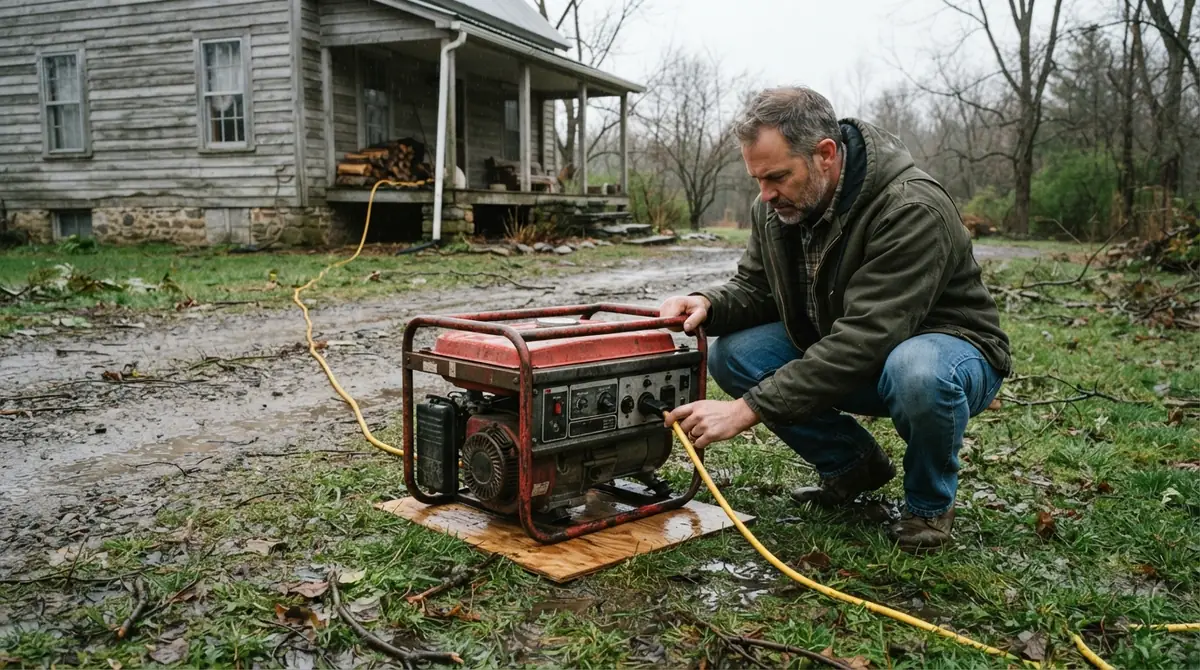
- Outdoors only, well away from the house. Carbon monoxide kills quietly and quickly. Never in a garage, never in a crawlspace, never under an open window — and not in the pump house.
- Watch for a pump that hums and does not start. Shut it down. That is the generator failing to deliver the surge, and every attempt heats the motor. The symptom is the one described in running but no water.
- Use the water sparingly. Fewer starts means less strain on the generator and less fuel burned.
- Consider a soft starter. A soft start device cuts the inrush substantially and can let a smaller generator run a pump it otherwise could not. Worth pricing against the next generator size up.
One thing worth doing before you need it: run the generator on the pump for ten minutes on a calm afternoon. Finding out that it cannot start the pump is much better done then than at nine at night in a storm, which is the situation covered in no water at night or on a weekend.
Where we work
Well pump service across Upstate South Carolina
| ✓Anderson | ✓Greer |
| ✓Taylors | ✓Mauldin |
| ✓Simpsonville | ✓Fountain Inn |
| ✓Travelers Rest | ✓Easley |
What to remember
| 1 | Size on the surge. Running watts are the small number. Starting watts decide whether it works at all. |
| 2 | Check for a 240V outlet. Watts are irrelevant if the voltage is wrong for the pump. |
| 3 | Transfer switch, never a wall socket. Backfeeding can kill the crew restoring your power. |
| 4 | A humming pump means stop. The generator is not delivering the surge and the motor is cooking. |
| 5 | Test it in fair weather. Ten minutes on a quiet afternoon tells you what a storm otherwise will. |
Frequently asked questions
What size generator do I need for a well pump?
For a 1/2 HP submersible, around 5,000 watts. For 3/4 HP, 6,500 and up. For 1 HP, 7,500 to 8,000. Those figures allow for the starting surge, which is three to six times the running load, and leave a little headroom for other essentials.
Will a 3,500 watt generator run a well pump?
Usually not. It may match the running load of a small pump but rarely covers the starting surge, and it often has no 240V outlet at all. A pump that hums without starting is the symptom of exactly this.
Can I plug a generator into a wall outlet to power my house?
No. Backfeeding through a socket energises the utility line and has killed line workers. It is illegal and voids insurance. Use a transfer switch or interlock kit fitted by a licensed electrician.
Does a well pump need 240 volts?
Most residential submersibles do. Many shallow-well jet pumps run on 120V. Check the data plate on the control box before buying anything, because a 120V-only generator cannot run a 240V pump regardless of its wattage.
Can running a well pump on a generator damage it?
An undersized generator can. The voltage sags, the motor fails to reach speed, and it overheats while still drawing starting current. A correctly sized generator does no harm at all.
How long can I run a generator during an outage?
As long as fuel and oil allow, with breaks per the manufacturer’s instructions. The practical limit is usually fuel. Running the pump only when water is needed stretches both the fuel and the engine.
Is a soft starter worth fitting?
Often yes. It reduces the inrush current substantially, which can let a smaller generator start a pump it otherwise could not, and it eases the strain on the motor during normal utility operation too.
Not sure what your pump draws?
We can tell you before you buy a generator
Horsepower, voltage and actual measured starting current from your own pump — so you size a generator against real figures rather than a chart, and do not find out it was too small during a storm.
Open 7am–9pm, seven days · No call-out fee with a repair · Fixed price agreed in writing
For what to do in an outage before the generator is running, see no water at night or on a weekend. For how Upstate wells and their equipment behave through the year, see the Upstate well owner’s guide.