
A tripping breaker feels like a nuisance fault. The lights are on, everything else works, and flipping one switch brings the water back for a while. That framing is what makes it dangerous. A breaker is not an inconvenience; it is the only thing standing between a fault in a buried 240-volt circuit and the rest of your house.
So the useful question is never how to stop it tripping. It is what it is tripping on.
What a trip actually means
Breakers respond to two different conditions, and telling them apart narrows the fault down immediately.
An overload is too much current for too long. The motor is working harder than it was designed to, heat builds, and the breaker opens after a delay — seconds or minutes, not instantly.
A short or ground fault is current taking a path it should not. Insulation has failed somewhere and electricity is finding earth. This trips the instant power is applied, every time, with no warm-up period.
Reset it once. Not twice. If it trips again, stop. Every reset sends full starting current into whatever is wrong — a motor already overheating, or a cable already leaking to earth. Motors that could have been saved are routinely destroyed in the hour between the first trip and the phone call.
The four realistic causes
1. The motor is drawing too much current
Bearings wear, sand gets into the impellers, or the windings begin to degrade. The pump still runs, but it pulls more amps than its rating to do the same work, and heat builds until the breaker opens.
The tell is timing: the pump runs for a while — often longer on cool days, shorter on hot ones — and then trips. A motor drawing high current is usually the end of a long story rather than a sudden event, and it is often visible on a meter months earlier. That is most of the argument for annual maintenance.
2. A ground fault in the drop cable
The cable running down the well to a submersible pump is spliced, buried, and permanently wet. Insulation fails at a splice, gets nicked against the casing, or simply degrades with age. Once it does, current leaks to earth.
The tell is instant, repeatable tripping the moment you reset. No delay, no running. This is not a pump fault at all, which matters — the pump may be perfectly good, and diagnosis has to happen before anyone sells you a new one.
3. A failed capacitor or control box
Many submersibles start through a control box mounted near the tank, containing a start capacitor and relay. A capacitor that has failed cannot give the motor the kick it needs, so the motor stalls at full locked-rotor current instead of spinning up.
The tell is a hum or click at the pump with no water, followed by a trip within seconds. This is one of the cheaper faults on the list — see pressure switch and control box repair.
4. Water where it should not be
The pressure switch and control box are electrical enclosures sitting in damp places. A cracked cover, a failed seal, or condensation in a well house lets water in, and water across live terminals trips a breaker reliably.
The tell is that trips began after heavy rain, a freeze, or work near the well head. Worth a look before anything expensive is assumed — it is often visible as corrosion or water staining inside the cover.
Narrowing it down by timing
| Trips instantly, every time | Ground fault or dead short — usually the drop cable or a wet enclosure. Stop resetting. |
| Trips after a few seconds, with a hum | Motor not starting — capacitor, relay, or a seized pump. |
| Trips after minutes of running | Overload — worn motor, sand, or a pump running against a restriction. |
| Trips intermittently, worse in hot weather | Marginal overload, or a breaker that has weakened with age and heat. |
| Started after rain or a freeze | Water ingress at the switch, control box, or well head. |
The cause people miss
A pump that is short cycling can trip a breaker without anything being wrong with the pump at all. Each start draws several times normal running current. Enough starts in quick succession and the cumulative heat opens the breaker — especially in summer, when the panel is already warm.
If the pump was clicking on and off in short bursts before the tripping began, check the tank before assuming an electrical fault. That sequence points at a waterlogged pressure tank, and the fix is a fraction of the cost of anything electrical.
What you can safely check yourself
The panel is the limit. Nothing here involves opening an enclosure or touching a terminal.
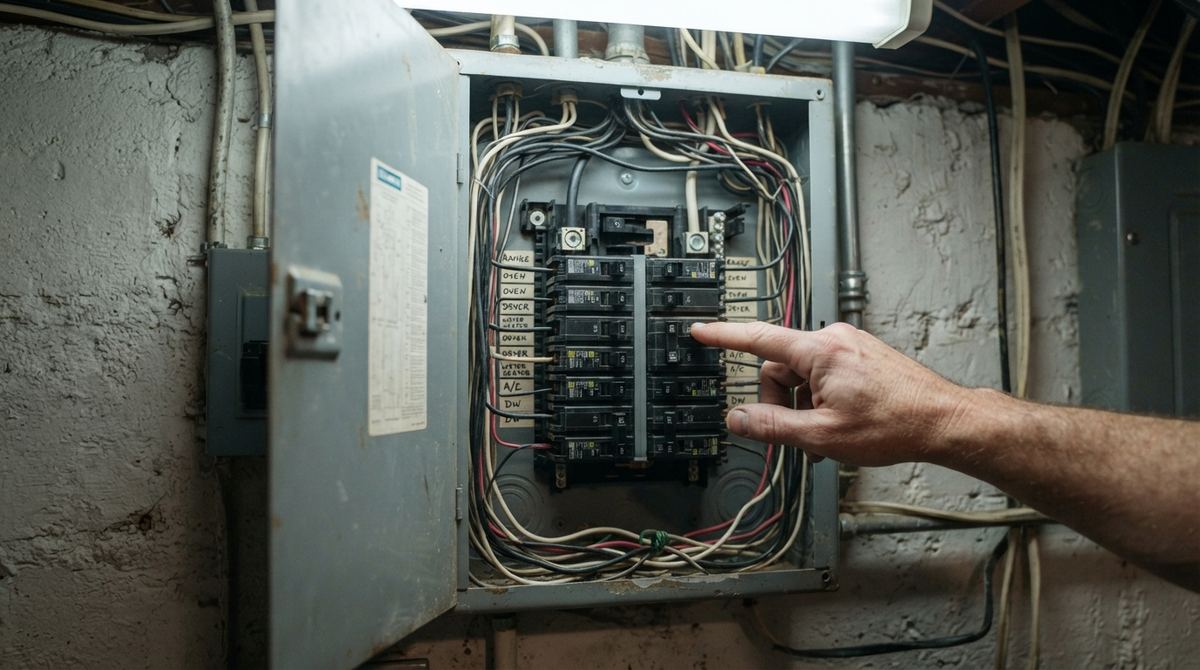
- Confirm it is actually the pump circuit. Well pumps usually sit on a double-pole 240V breaker. If a neighbouring breaker is tripping instead, the fault is elsewhere entirely.
- Look, do not open. Check the outside of the pressure switch and control box for cracks, water staining, or rust streaks below the cover.
- Note the timing. Instantly, after seconds, or after minutes — write it down. This single detail saves diagnostic time and therefore money.
- Check what changed. Storm, freeze, power cut, digging near the well, new irrigation system. Faults rarely appear from nothing.
- Leave it off if it keeps tripping. No water for a night is recoverable. A burnt-out motor is not.
Beyond that, diagnosis needs a meter: insulation resistance to earth on the drop cable, amp draw under load, and voltage at the control box. Those readings separate a cable fault from a motor fault, and the difference between them is large enough that guessing is expensive. More on that in what to check before you call.
What it is likely to cost
The split is the usual one on well systems: everything above ground is modest, and anything requiring the pump to be pulled is not.
A pressure switch, capacitor, control box or breaker is an above-ground job. A drop cable fault or a failed motor means pulling the submersible — and if the pump is out of the ground and near end of life, replacing it at the same time is normally the cheaper decision over any sensible horizon. The full picture is in how much well pump repair costs and well pump replacement.
Where we work
Well pump electrical diagnosis across Upstate South Carolina
| ✓Anderson | ✓Greer |
| ✓Taylors | ✓Mauldin |
| ✓Simpsonville | ✓Fountain Inn |
| ✓Travelers Rest | ✓Easley |
What to remember
| 1 | Reset once, then stop. Repeated resets destroy motors that a single diagnosis could have saved. |
| 2 | Timing is the diagnosis. Instant means a ground fault. Delayed means an overload. Note which one you have. |
| 3 | A tripping breaker is not always a dead pump. Cables, capacitors and switches all trip breakers, and all cost far less. |
| 4 | Never fit a bigger breaker. It does not fix the fault; it removes the protection and puts the load on the wiring instead. |
| 5 | Check the tank first if it was cycling. Short cycling trips breakers, and it is the cheapest fault on this page. |
Frequently asked questions
Why does my well pump keep tripping the breaker?
Because something is drawing excess current or leaking it to earth. The four common causes are a motor drawing high amps as it wears, a ground fault in the drop cable, a failed start capacitor or control box, and water inside the pressure switch or control box.
Is it safe to keep resetting the breaker?
No. One reset is reasonable, in case the trip was a one-off surge. After that, every reset pushes full starting current into a motor that may be overheating or a cable that is already leaking to earth, and both faults get worse rather than better.
Can I fix a tripping well pump breaker myself?
You can identify the timing pattern and check the outside of enclosures for water damage. Beyond that it needs meter readings on a 240-volt circuit, including insulation resistance on the buried cable, so the work itself belongs with someone qualified.
Does a tripping breaker mean my pump is dead?
Not necessarily, and this is worth insisting on before anyone quotes for a new pump. Cable faults, capacitors, switches and wet control boxes all trip breakers while the pump itself is fine.
Should I install a larger breaker to stop it tripping?
No. The breaker is sized to protect the wiring. A larger one allows the fault to keep drawing current through cable that was never rated for it, which turns an electrical fault into a fire risk.
Why does it only trip in hot weather?
Breakers are thermal devices, so a marginal overload that passes in winter will trip in July. It usually means the motor is already drawing more than it should and the ambient heat is just tipping it over the line.
The breaker trips instantly every time. What does that mean?
A dead short or a ground fault, most often in the buried drop cable or inside a water-damaged enclosure. Leave the breaker off and have it tested rather than continuing to reset it.
Breaker off and no water?
We test before we replace anything
Insulation resistance on the drop cable, amp draw under load, and voltage at the control box — the readings that separate a cheap fault from an expensive one. You get the numbers, then the price, then the decision.
Open 7am–9pm, seven days · No call-out fee with a repair · Fixed price agreed in writing
If you have no water right now, see emergency well pump repair. For the switch and control box side of it, see pressure switch and control box repair, or tell us when it trips and we will tell you what it points at.