
There is a moment in a lot of well problems where the equipment has been checked, everything measures correctly, and there is still not enough water. At that point the question stops being about hardware and starts being about geology.
That question has an answer, and it is measurable.
Yield and flow are not the same thing
Yield is how many gallons per minute the aquifer can deliver into the well over a sustained period. It is a property of the ground — the rock, the fractures, the water table. No pump changes it.
Flow rate is how many gallons per minute arrive at a fixture. It depends on the pump, the pipe, the pressure settings, the height water has to be lifted, and any restriction along the way.
Why the distinction earns its keep. Poor flow with good yield is an equipment problem, and equipment can be fixed. Poor yield is a well problem, and the answer is storage or usage management rather than a bigger pump. Fitting a larger pump to a low-yield well makes things worse: it draws the well down faster and runs the pump dry.
Signs it is the well and not the pump
Water runs out, then returns
Full pressure for fifteen or twenty minutes, then a decline to nothing, then normal service again an hour or two later. That is drawdown and recovery. No pump fault behaves this way.
Air spitting from the taps
The water level has fallen to the pump intake and it is pulling air. Switch the pump off if this happens — running dry is how pumps die suddenly rather than gradually.
It only happens in late summer
Seasonal drawdown after a dry spell. Wells in fractured Piedmont bedrock are more sensitive to this than deep sandy aquifers, and the same well can behave perfectly in April and struggle in September.
Sediment appears when demand is high
Sand or cloudiness during heavy use suggests the water level is dropping near the intake and disturbing the bottom of the well.
If instead the pressure is simply weak all the time, with no time pattern, that is an equipment or elevation issue — start at why your well water pressure is low.
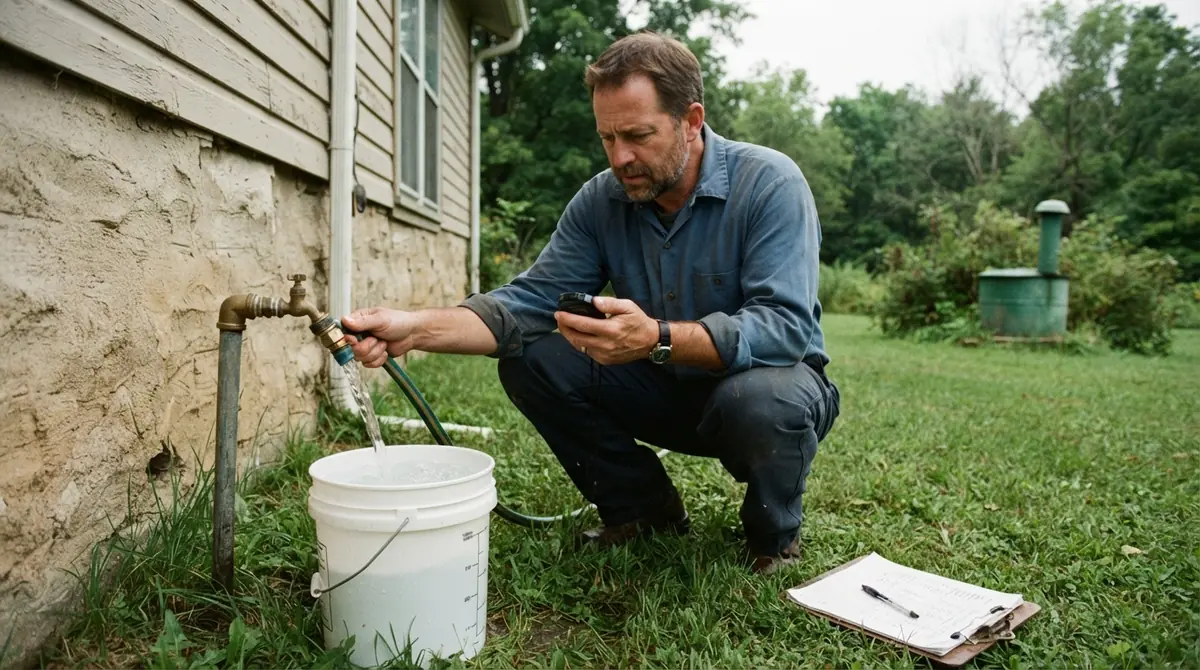
The test you can do yourself
This measures flow, not yield, but it is genuinely useful and takes five minutes.
| 1 | Take an outside spigot, a five-gallon bucket, and a stopwatch. Do this when nothing else in the house is running. |
| 2 | Open the spigot fully and time how long the bucket takes to fill. |
| 3 | Divide 300 by the seconds taken. Sixty seconds gives 5 GPM, forty gives 7.5, ninety gives 3.3. |
| 4 | Now leave the spigot running for thirty minutes and repeat the measurement. If the second figure is much lower, the well is drawing down. |
That last step is the informative one. A flow rate that holds steady over thirty minutes points at equipment if there is a problem at all. A flow rate that falls away points at the well.
Record the number and the date. Repeated annually, it turns a vague impression that the water “isn’t what it was” into a trend you can actually see. That is why it belongs on the annual maintenance list.
What the numbers mean
| Under 3 GPM | Low. Workable for a small household with storage, but it will not support irrigation or simultaneous fixtures. |
| 3–5 GPM | Common on Piedmont wells and adequate for typical household use with a properly sized tank. |
| 5–10 GPM | Comfortable. Handles a family home with some irrigation without much thought. |
| Over 10 GPM | Strong. Effectively no residential constraint. |
These are yield figures, and they are guidance rather than regulation — a household of two with a large storage tank manages happily on a yield that would frustrate a household of six. What matters is yield against actual demand, not the number in isolation.
What a professional test adds
A proper yield test measures what a bucket cannot: the static water level before pumping, the drawdown level under sustained pumping, and how quickly the well recovers afterwards. Together those give the sustainable yield rather than a snapshot.
It is worth doing when you are buying a property with a well, when adding bathrooms or irrigation, when a pump has failed repeatedly and nobody has established why, or when output has visibly declined over years. Pump sizing depends on it — a pump specified without knowing the drawdown level is a pump specified by guesswork. See water flow and pressure testing, and, if you are buying, what to check before you close.
If the yield really is low
A bigger pump is the wrong answer and usually an expensive one. The options that work are about storage and demand:
- A storage tank. A low-yield well filling a large tank slowly, with a second pump delivering from the tank, converts a rate problem into a volume problem. This is the standard solution.
- A low-pressure cut-off switch. Protects the pump from running dry when the well draws down — cheap, and fitted with a switch replacement it costs almost nothing extra.
- Repositioning the pump. Sometimes it is set too high in the casing and there is usable water below it. Worth checking before anything drastic.
- Managing demand. Irrigating at night, spacing out laundry and showers. Unglamorous, free, and often enough on its own.
- Deepening or hydrofracturing. A drilling contractor’s work rather than a pump contractor’s, and a real option on some wells — but a last resort after the cheaper routes.
Where we work
Flow and yield testing across Upstate South Carolina
| ✓Anderson | ✓Greer |
| ✓Taylors | ✓Mauldin |
| ✓Simpsonville | ✓Fountain Inn |
| ✓Travelers Rest | ✓Easley |
What to remember
| 1 | Runs out then comes back is the well. No pump fault produces that pattern. |
| 2 | A bigger pump cannot create water. On a low-yield well it draws down faster and runs the pump dry. |
| 3 | Test twice, thirty minutes apart. Steady means equipment. Falling means the well. |
| 4 | Storage beats horsepower. The standard fix for low yield is a tank, not a stronger pump. |
| 5 | Write the number down each year. A trend tells you far more than a single reading ever will. |
Frequently asked questions
What is a well yield test?
A measurement of how fast the aquifer refills the well, in gallons per minute, taken over a sustained period. It records the static water level, the drawdown level under pumping, and the recovery rate afterwards.
What is a good well flow rate for a house?
Between 3 and 5 GPM suits most households with a properly sized pressure tank, and 5 to 10 GPM is comfortable including some irrigation. Below 3 GPM usually needs storage. What matters is yield against your actual demand rather than the number alone.
How can I test my well flow rate myself?
Time how long a five-gallon bucket takes to fill from an outside spigot with nothing else running, then divide 300 by the seconds taken. Repeat after thirty minutes of continuous flow — a large drop between the two readings means the well is drawing down.
Is low water pressure the same as low well yield?
No, and treating them as the same is how people end up buying pumps that solve nothing. Low pressure is usually equipment or elevation. Low yield shows up as water that runs out during extended use and returns later.
Will a bigger pump fix a low-yield well?
No. It draws the well down faster and increases the risk of running the pump dry. Storage tanks, demand management and a low-pressure cut-off are the workable answers.
Why does my well run dry only in late summer?
Seasonal drawdown. Water levels in fractured bedrock fall after a dry spring and summer, and the same well can perform perfectly in April and struggle in September. It is a characteristic of the well rather than a fault.
Should I get a yield test before buying a house with a well?
Yes. A standard home inspection usually confirms only that water comes out of the taps, which says nothing about whether the well can sustain a household. More on that in buying a house with a well.
Water running out during showers?
Find out if it is the well or the pump
We measure static level, drawdown under sustained pumping, recovery rate and delivered flow — and give you the figures in writing, so any decision about pumps or storage is made against real numbers.
Open 7am–9pm, seven days · No call-out fee with a repair · Fixed price agreed in writing
Full detail on the testing itself is under water flow and pressure testing. For how Upstate wells behave through the year, see the Upstate well owner’s guide.