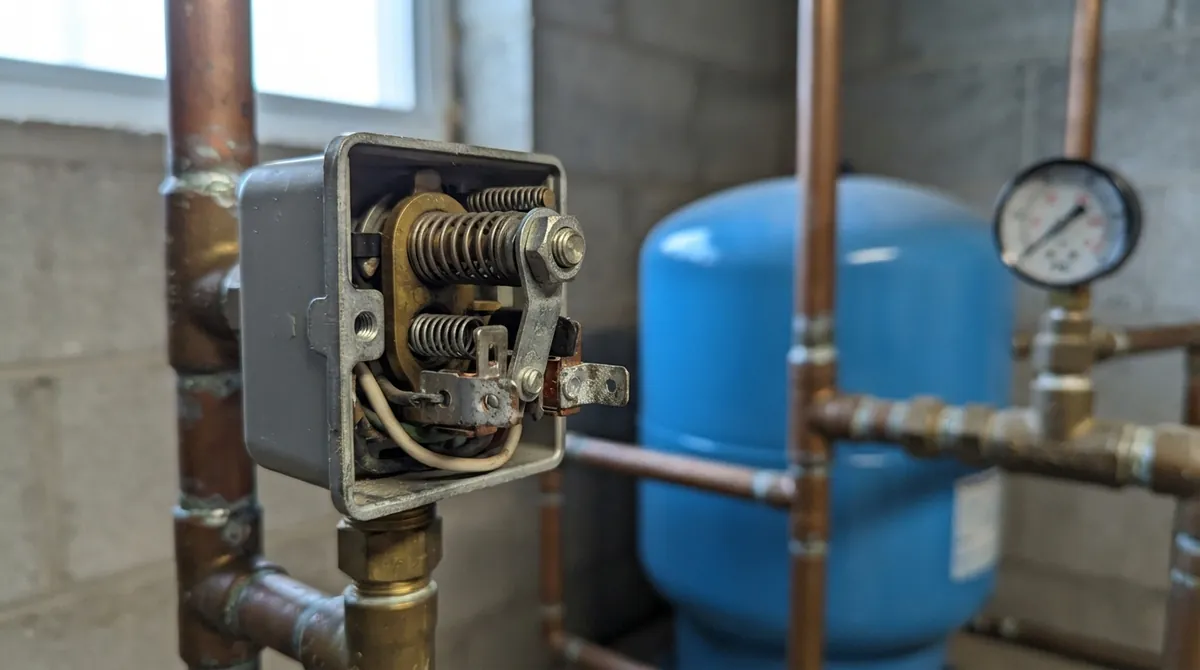

Almost every well system has one, and almost nobody knows where it is. It is the grey or black box, roughly the size of a fist, mounted on a small pipe near the pressure tank, with a cover held on by a single nut.
Inside is a diaphragm pushing against a spring, opening and closing a pair of electrical contacts. That is the entire mechanism, and it is responsible for every start and stop your pump makes. Given how much depends on it, it is a remarkably cheap component — which is the good news buried in most of the symptoms below.
What the numbers mean
A switch is described by two figures. Cut-in is the pressure at which it closes the contacts and starts the pump. Cut-out is the pressure at which it opens them and stops it.
A 30/50 switch starts the pump at 30 PSI and stops it at 50. A 40/60 switch starts at 40 and stops at 60. The 20 PSI gap between them is what gives the system room to store water — narrow that gap and the pump has nowhere to work.
The switch and the tank are a matched pair. Tank air charge must sit two PSI below cut-in — 28 for a 30/50 system, 38 for a 40/60. Change the switch setting without re-charging the tank and you have created a fault while trying to fix one. See checking the tank air charge.
Six signs the switch is failing
1. No water, and no sound from the pump
Contacts that have burned or welded open will not close the circuit, so the pump never receives power. Nothing hums, nothing clicks. This is the classic switch failure, and it is often mistaken for a dead pump.
2. The pump will not shut off
The opposite failure: contacts welded closed, or a diaphragm that no longer responds. The pump keeps running past its cut-out point. This one is urgent — a pump running continuously against a closed system overheats quickly.
3. Chattering or buzzing at the switch
A rapid clicking from the switch itself means the contacts are making and breaking dozens of times a second. That is arcing, it burns the contacts fast, and it is not something to leave running.
4. The pump starts at the wrong pressure
You know it should cut in at 40 and the gauge says 25. The spring has weakened or the calibration has drifted. Common on switches past ten years old.
5. It only fails after heavy rain
Water inside the cover. The enclosure is not sealed against a soaking, and moisture across the terminals causes intermittent operation or trips the breaker — see why your breaker keeps tripping.
6. Cycling that the tank does not explain
If the tank has been checked and correctly charged and the pump still cycles rapidly, the small tube feeding the switch has probably silted up. The switch is then reading a pressure the system is not actually at. More on that pattern in why your pump keeps turning on and off.
Choosing between 30/50 and 40/60
Higher is not automatically better, and this is where a lot of well-meant DIY goes wrong.
| 30/50 | Single-storey homes, older pumps, and systems with plumbing that would not thank you for more pressure. Gentler on everything. |
| 40/60 | Two-storey homes, upstairs bathrooms, and anywhere fixtures sit well above the tank. The usual default on newer builds. |
| Higher than 40/60 | Rarely appropriate on residential systems. It stresses the pump, the tank and the plumbing, and most pumps cannot reliably reach cut-out anyway. |
The constraint people forget is the pump. If the pump cannot build to the cut-out pressure, it never shuts off — it just runs. Setting a 40/60 switch on a pump that tops out at 52 PSI produces a pump that runs continuously until it burns out. Any change in setting has to be checked against what the pump actually delivers.
If the reason you are considering a higher setting is weak pressure, read why your well water pressure is low first. Turning the switch up is the fix for roughly one low-pressure cause out of five, and it makes several of the others worse.
Why a well pressure switch replacement is not a DIY job
The part is inexpensive and the physical job looks simple, which is exactly why it goes wrong.
The switch sits on a live 240-volt circuit. It has to be replaced with the breaker off, the system depressurised, and the tube cleared — and then the tank charge has to be re-checked against the new cut-in, because a new switch calibrated differently from the old one leaves the tank mismatched. Skipping that last step is the most common reason a new switch fails within months.
There is also a variant worth knowing about. A low-pressure cut-off switch shuts the pump down if pressure falls below a threshold, which protects it from running dry when the well is drawing down. On wells that struggle in late summer, fitting one during a switch replacement is a cheap addition that can save a pump outright.
Where we work
Pressure switch replacement across Upstate South Carolina
| ✓Anderson | ✓Greer |
| ✓Taylors | ✓Mauldin |
| ✓Simpsonville | ✓Fountain Inn |
| ✓Travelers Rest | ✓Easley |
What to remember
| 1 | Switch failure imitates pump failure. No water and silence from the pump is a switch symptom before it is a pump symptom. |
| 2 | A pump that will not stop is urgent. Switch it off at the breaker rather than letting it run against a closed system. |
| 3 | Every setting change needs a tank re-charge. Two PSI below the new cut-in, or the new switch inherits an old fault. |
| 4 | Do not chase pressure with the switch. If the pump cannot reach cut-out, it will simply never stop running. |
| 5 | Ask about a low-pressure cut-off. On a well that draws down in summer, it is cheap insurance fitted at the same visit. |
Frequently asked questions
What are the symptoms of a bad well pressure switch?
No water with no sound from the pump, a pump that will not shut off, rapid clicking or buzzing at the switch, a pump starting at the wrong gauge pressure, and intermittent operation after heavy rain.
What is the difference between 30/50 and 40/60?
The numbers are the cut-in and cut-out pressures. A 30/50 switch starts the pump at 30 PSI and stops it at 50; a 40/60 switch starts at 40 and stops at 60. Higher settings suit two-storey homes with upstairs fixtures.
Can I change my pressure switch from 30/50 to 40/60?
Sometimes, but only if the pump can actually build to 60 PSI and the tank air charge is re-set to 38 to match. If the pump cannot reach the new cut-out, it will run continuously and burn out.
How long does a well pressure switch last?
Typically eight to twelve years, though it depends heavily on how often the pump cycles. A system that has been short cycling will burn through switch contacts far faster than that.
Why does my pressure switch click rapidly?
The contacts are making and breaking repeatedly, which is arcing. It usually points at a waterlogged tank, a clogged switch tube, or a switch at the end of its life. It should not be left running.
Can I replace a well pressure switch myself?
It is a live 240-volt circuit, and the job includes depressurising the system, clearing the sensing tube, and re-checking the tank charge against the new cut-in. The last step is the one most often skipped, and skipping it is why replacement switches fail early.
What is a low-pressure cut-off switch?
A variant that shuts the pump down if pressure falls below a set threshold, protecting it from running dry when the well draws down. Worth fitting on wells that struggle in late summer.
Switch clicking, or pump not stopping?
Replaced and calibrated the same day
We check what the pump can actually deliver before setting anything, clear the sensing tube, and re-charge the tank to match. You leave with a system that agrees with itself.
Open 7am–9pm, seven days · No call-out fee with a repair · Fixed price agreed in writing
Full detail on the part and the work is on pressure switch and control box repair. If the tank is the more likely suspect, start at pressure tank service — or tell us your cut-in and cut-out numbers and we will tell you whether they make sense together.