
Most people meet this fault without knowing what it is called. The pump starts clicking on and off in short bursts. The shower pressure surges and drops. Somebody says the pump is on its way out, and sometimes a pump does get replaced — when the actual fault was a component costing a fraction of it, sitting three feet away.
The pressure tank is the least glamorous part of a well system and the one that decides how long everything else lasts.
What the tank is actually for
A well pump has no ability to modulate. It runs at full output or it is off. Without something in between, opening a tap would start the motor, closing it would stop the motor, and a normal household day would mean hundreds of starts.
The pressure tank is that something in between. Inside it is a volume of compressed air, usually separated from the water by a rubber bladder or diaphragm. As the pump fills the tank, the air compresses. When you open a tap, that compressed air pushes water back out — and the pump stays off until the pressure falls to the cut-in point.
The useful part is called drawdown: the water you can actually draw before the pump has to start. On a healthy tank it is roughly a third of the tank’s stated volume. On a waterlogged tank it is close to nothing.
This is why it matters so much. A pump is worn out by starting, not by running. Every start pushes a heavy surge of current through the motor windings. A tank that has waterlogged can take a pump from a hundred starts a week to a hundred starts a day — and that is the difference between twelve years of service and two.
What goes wrong
There are two designs in the field, and they fail differently.
Bladder and diaphragm tanks are what almost all modern systems use. The rubber separating air from water eventually splits or perishes. Once it does, water floods into the air side and the tank is finished — there is nothing left to recharge.
Older galvanised tanks have no bladder at all; air sits directly on top of the water. Air slowly dissolves into the water and leaves with it. These tanks waterlog gradually and legitimately, and adding air back is the correct fix rather than a sign of failure.
A third cause is worth naming because it gets missed: a tank that was never charged correctly in the first place. Air charge has to be set against the pump’s cut-in pressure. Fitted straight from the box at the factory setting, on a system running different pressures, a tank behaves badly from day one.
Five signs your tank has waterlogged
1. The pump cycles in short bursts
The clearest sign. The pump starts and stops every few seconds while a tap is running, instead of running for a minute or more and then resting. This is short cycling, and the tank is behind it far more often than the pump is.
2. The gauge needle swings fast
Watch the pressure gauge near the tank with a tap open. It should climb and fall steadily between two points about 20 PSI apart. On a waterlogged tank the needle jumps between them in seconds.
3. The tank sounds solid all the way up
Knock on the side, near the top and near the bottom. Healthy is hollow at the top, solid at the bottom, with an audible change somewhere in between. Solid from top to bottom means it is full of water.
4. It feels heavy and cold at the top
Same test, different sense. The upper section of a healthy tank sits at room temperature. A waterlogged one is cold to the touch all the way up, because there is well water behind the steel.
5. Pressure collapses the moment you open a tap
Full pressure for a second or two, then an immediate drop until the pump catches up. There is no stored water to bridge the gap. If your pressure problem is steady rather than surging, the cause is more likely to be elsewhere — see why your well water pressure is low.
How to check the air charge
This is a homeowner job. It involves no wiring and no dismantling. What it does require is doing the steps in order, because a reading taken on a pressurised tank is meaningless.
| 1 | Note your cut-in pressure. Watch the gauge and write down the number at which the pump switches on. Commonly 30 or 40. You need this before you touch anything else. |
| 2 | Switch off the pump breaker. Not the switch on the pump — the breaker. The system must not be able to refill while you are working. |
| 3 | Drain it to zero. Open the drain valve at the tank, or the lowest tap in the house, and let it run until the gauge sits at 0 PSI and nothing more comes out. |
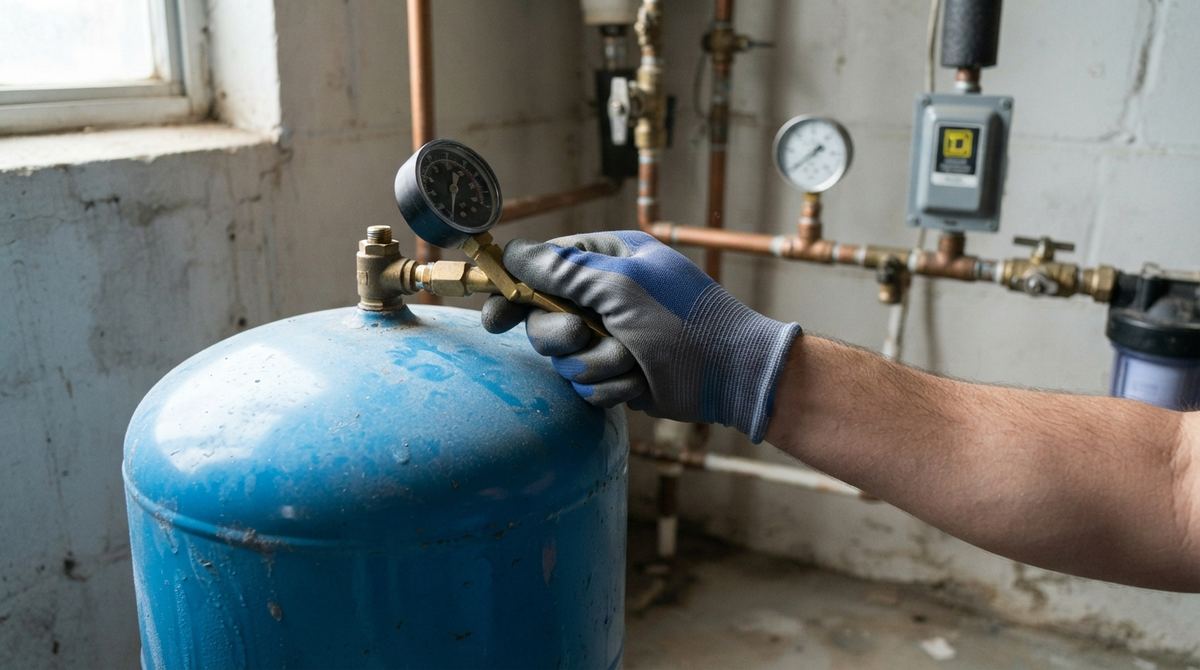
| 4 | Read the air valve. Under the cap on top of the tank is a valve identical to the one on a car tyre. Put a tyre gauge on it and take the reading. |
| 5 | Compare it to cut-in minus two. A 30/50 system wants 28 PSI. A 40/60 system wants 38. That two PSI margin is what stops the tank emptying completely on every cycle. |
What the reading tells you:
- Well below target — the tank has lost air and needs recharging. Normal, and fixable in minutes.
- Zero, or almost nothing — either it has emptied completely or the bladder has gone. Step 6 settles it.
- Above target — overcharged. The pump will run longer than it should and the tank will still deliver poorly. Bleed it down.
Step 6 — the test that decides everything. Press the pin in the centre of the air valve. If air hisses out, the bladder is intact and the tank can be recharged. If water comes out, the bladder has ruptured. No amount of air will fix that tank — it needs replacing.
Recharging it
With the system still drained and the breaker still off, put air in through the same valve using a bicycle pump or a compressor set low. Add it in short bursts and re-check with the gauge as you go. Overshooting and bleeding back down is slower than creeping up on the number.
When it reads two PSI below cut-in, replace the cap, close the drain valve, and switch the breaker back on. Let the system fill and watch one full cycle. The pump should now run for a decent stretch and then rest properly.
Then note the date. If the same tank is flat again within a few weeks, it is not holding air, and the answer is a new tank rather than a recharge every month.
When the tank has to be replaced instead
Recharging is the right answer often, but not always. Replace rather than recharge when:
- Water comes out of the air valve. The bladder has failed. This is not repairable.
- It will not hold the charge. Flat again within weeks means a leak somewhere in the shell or the valve.
- There is rust at the seams or the base. A tank corroding from the inside is on a clock, and it fails wet.
- The house has outgrown it. A tank sized for two bathrooms cannot buffer four, no matter how perfectly it is charged. This is a sizing problem wearing the costume of a tank fault.
Tank work is at the cheap end of well repairs, because everything happens above ground — the cost scale is set out in how much well pump repair costs. The expensive scenario is the one where a waterlogged tank runs unnoticed for a year and takes the pump with it.
When it is not the tank
Short cycling has one dominant cause, but not only one. If the tank checks out correctly, look at:
- The pressure switch. Contacts pit and burn, or the cut-in and cut-out points drift together until the gap is too narrow to give the pump anywhere to work. See pressure switch and control box repair.
- A clogged switch tube. The small pipe feeding the switch silts up, so the switch is reading a pressure the system is not actually at.
- A leak between the tank and the house. Constant small demand keeps the pump waking up. Watch whether it starts with every tap in the house closed.
- A failed check valve. Water drains back down the well between cycles, so the tank never stays full.
A note on Upstate wells
Two local habits make tank faults commoner here than they need to be. Irrigation is the first — sustained summer draw exposes a marginal tank that indoor use never troubled, which is why these calls cluster around the Golden Strip in July. Elevation is the second: properties in the foothills often run higher cut-out settings to reach upstairs fixtures, and a higher setting is unforgiving of a tank that is even slightly off.
Wider context on how wells behave in this region is in the Upstate well owner’s guide.
Where we work
Pressure tank service across Upstate South Carolina
| ✓Anderson | ✓Greer |
| ✓Taylors | ✓Mauldin |
| ✓Simpsonville | ✓Fountain Inn |
| ✓Travelers Rest | ✓Easley |
What to remember
| 1 | Two PSI below cut-in. That single number is the whole specification. 28 on a 30/50 system, 38 on a 40/60. |
| 2 | Drain to zero before you measure. A reading on a pressurised tank tells you nothing at all. |
| 3 | Water at the air valve means a new tank. The bladder has gone, and no amount of air brings it back. |
| 4 | Do not leave short cycling running. Every hour it continues is motor life you are spending. |
| 5 | Check it once a year. Fifteen minutes annually protects the most expensive component you own. Details in well pump maintenance. |
Frequently asked questions
What does a waterlogged pressure tank mean?
It means the tank has lost the compressed air that lets it store water under pressure, so it has filled with water instead. The tank still passes water through, but it no longer holds any in reserve, and the pump has to start every time water is used.
How do I know if my pressure tank is waterlogged?
Knock on the side of the tank. Hollow near the top and solid near the bottom is healthy; solid all the way up means it is full of water. Rapid pump cycling and a pressure gauge needle that swings quickly are the other reliable signs.
What should the air pressure in my well pressure tank be?
Two PSI below the pump’s cut-in pressure, measured with the tank fully drained. A 30/50 system should read 28 PSI and a 40/60 system should read 38 PSI.
Can I recharge a waterlogged pressure tank myself?
Yes, if the bladder is intact. Switch off the pump breaker, drain the tank to zero, and add air through the valve on top with a bicycle pump or a low-set compressor until it reads two PSI below cut-in. If water comes out of that valve instead of air, the tank needs replacing.
How long does a pressure tank last?
Between eight and fifteen years for a bladder tank, less if it has spent years at the wrong charge. It is a consumable part, and a far cheaper one than the pump it protects — expected pump life is covered in how long a well pump lasts.
Will a waterlogged tank damage my well pump?
Yes, and it is the main way pumps die early. The damage comes from the number of starts rather than running hours, and a waterlogged tank multiplies starts many times over.
Why does my tank keep losing air?
A bladder tank that goes flat repeatedly has a leak, either in the bladder or at the valve, and needs replacing. Older galvanised tanks without a bladder lose air naturally as it dissolves into the water, and topping them up periodically is normal.
Cycling every few seconds?
Get the tank checked properly
We test the charge against your actual cut-in setting, confirm whether the bladder is intact, and tell you plainly whether it is a recharge or a replacement. Fixed price agreed before we start.
Open 7am–9pm, seven days · No call-out fee with a repair · Fixed price agreed in writing
If the tank turned out to be the problem, start with pressure tank service. If it checked out fine and the pump is still cycling, see well pump repair for what else it could be, or send us your gauge readings and we will tell you what they mean.