
The pressure tank is the part of a well system people think about least and depend on most. It is what lets you run a tap without the pump starting instantly, and what keeps the pump from starting every time someone washes their hands.
When it fails, the pump pays for it. That is why the decision between recharging and replacing matters, and why the size of the replacement matters even more.
Recharge or replace? The one test that decides it
If you have not yet read it, how to check and recharge a waterlogged tank covers the recharge process in full. The question here is whether recharging is worth doing at all.
With the power to the pump off, briefly press the pin on the air valve at the top of the tank — the same kind of valve as on a car tyre.
| Air comes out | The bladder is intact. The tank has lost some charge over time. Recharging is normally the right answer. |
| Nothing comes out | The charge is gone entirely. Recharge it and check again in a couple of weeks. If it has dropped again, there is a slow leak. |
| Water comes out | The bladder or diaphragm has ruptured and water is in the air side. The tank needs replacing. Recharging will buy a few days at most. |
Other signs a tank is finished
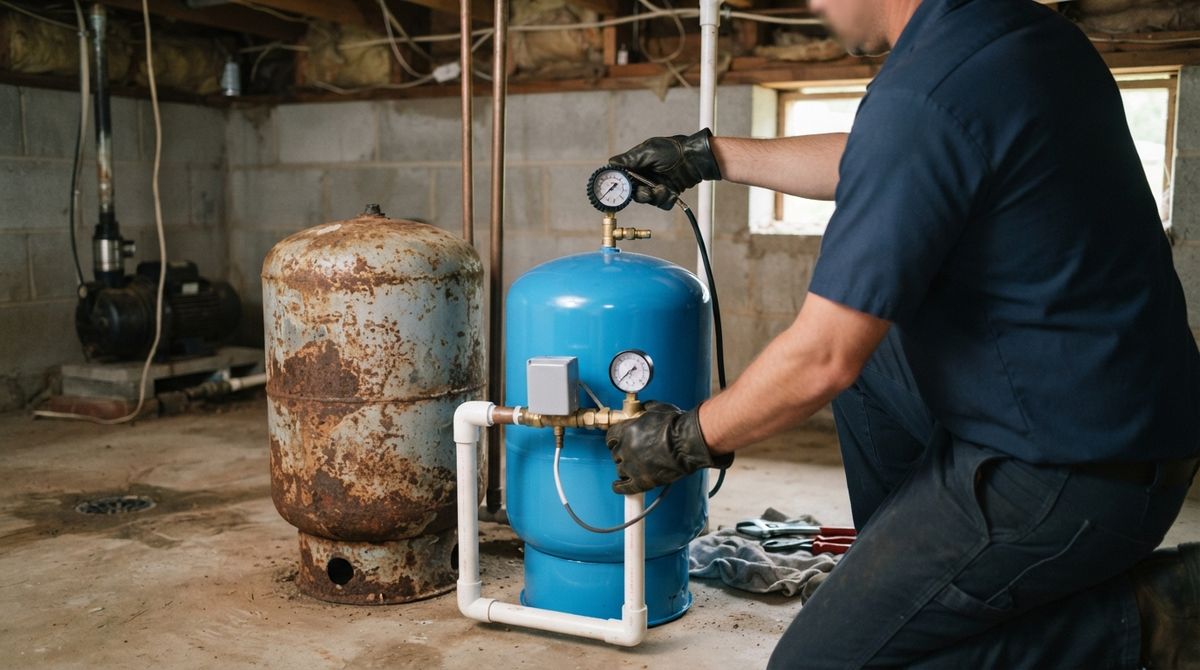
- Rust streaks or weeping at the seams or base. Once the steel shell is corroding through, it is a question of when, not if.
- The tank is very heavy and sounds solid all the way up. Knock on it from top to bottom. The top section should sound hollow.
- It keeps losing charge after recharging. A leaking air valve can be replaced cheaply. A leaking bladder cannot.
- It is an old galvanised tank with no bladder at all. These rely on an air cushion that constantly dissolves into the water, and they need attention far more often than a modern bladder tank.
How long a pressure tank lasts
A modern bladder or diaphragm tank commonly lasts around ten years, with a realistic range of roughly five to fifteen. Three things decide where yours falls:
- How often it cycles. A tank that is too small flexes its bladder far more often, and wears out sooner along with the pump.
- Water chemistry. Aggressive or sediment-heavy water shortens the life of the bladder and the fittings.
- Where it lives. A tank in a damp crawlspace or an unheated well house rusts from the outside. One that freezes can split.
An annual check of the air charge, part of the yearly well maintenance routine, is the single thing that adds most to a tank’s life.
Sizing: why the gallons on the label mislead
This is the part of pressure tank replacement most often done wrong.
A tank’s advertised size is its total volume. The number that matters is drawdown — how much water you can actually take from it between the pump switching off and switching back on. Most of the tank is air, compressed to push the water out.
As a rough guide, a tank on a 40/60 switch delivers somewhere around a quarter to a third of its nominal volume as drawdown. The exact figure depends on the switch setting and is printed in the manufacturer’s tables for each model.
The rule that protects the pump: most pump manufacturers want the motor to run for at least a minute every time it starts. The tank needs enough drawdown to make that happen at the pump’s flow rate. A pump delivering 10 gallons a minute needs roughly 10 gallons of drawdown — which means a considerably larger tank than most people expect.
Things that change the size you need
- Pump flow rate. Bigger pumps need bigger tanks, not the same tank.
- Switch setting. Moving from 30/50 to 40/60 changes the drawdown from the same tank.
- Household use. Irrigation, a large family or a second bathroom all argue for more storage.
- Space. Where a single larger tank will not fit, two tanks can be plumbed together.
A tank should be sized alongside the pump, not independently of it. If the pump is being replaced at the same time, see what size well pump you need.
What decides the cost of a pressure tank replacement
This is a surface job — no pulling of the pump, no lifting equipment — which makes it one of the more affordable significant repairs on a well system. The price moves with:
| Tank size and brand | Larger tanks cost more, and build quality varies. A properly sized tank is money saved on the pump. |
| Access | A tank in a crawlspace or tight closet takes longer to get out and a new one longer to get in. |
| The tank tee | The fitting that carries the gauge, switch, drain and relief valve. Often worth replacing at the same time. |
| The pressure switch | A switch that has been chattering through months of short cycling usually has pitted contacts. Replacing it alongside the tank is sensible. |
Setting up a new tank correctly
A new tank arrives with a factory air charge that is usually wrong for your system. Before it goes into service:
- Check the pressure switch’s cut-in setting.
- Set the tank’s air charge to about 2 psi below cut-in, measured with the tank empty of water.
- Confirm the switch cuts in and out at the right numbers once the system is running.
- Time a full cycle to confirm the pump runs for at least a minute.
A new tank installed at the wrong charge behaves like a waterlogged one, and the pump short cycles from the first day.
Where we work
Pressure tank service across Upstate South Carolina
| ✓Anderson | ✓Greer |
| ✓Taylors | ✓Mauldin |
| ✓Simpsonville | ✓Fountain Inn |
| ✓Travelers Rest | ✓Easley |
What to remember
| 1 | Water from the air valve means replace. Air or nothing means try a recharge first. |
| 2 | Size by drawdown. The label’s gallons are total volume, not usable water. |
| 3 | One minute minimum run time. The tank must give the pump that, every start. |
| 4 | Set the charge before use. About 2 psi below cut-in, with the tank empty. |
| 5 | Check it every year. Two minutes with a tyre gauge adds years to the tank and the pump. |
Frequently asked questions
How do I know if my pressure tank needs replacing?
Press the air valve on top of the tank with the power off. If water comes out, the bladder has failed and the tank needs replacing. Rust at the seams, weeping at the base or a tank that keeps losing charge after recharging are the other common signs.
How long does a well pressure tank last?
Commonly around ten years, with a realistic range of five to fifteen. Tanks that are undersized, exposed to damp or freezing, or handling aggressive water tend to fail sooner.
What size pressure tank do I need?
One with enough drawdown to let the pump run for at least a minute each time it starts. As a rough guide that means about one gallon of drawdown for every gallon per minute the pump delivers, which usually means a larger tank than the nominal size suggests.
Can I just recharge a waterlogged tank?
If the bladder is intact, yes. If water comes out of the air valve, the bladder has ruptured and recharging will only help for a few days.
What should the air pressure in my tank be?
About 2 psi below the pressure switch cut-in setting, measured with the pump off and the tank drained of water. For a 40/60 switch that is around 38 psi.
Is a bigger pressure tank better?
Up to a point, yes. More drawdown means fewer pump starts and longer pump life. The practical limits are space, cost and the water sitting in the tank between uses.
Should the pressure switch be replaced with the tank?
Often. A switch that has been chattering through months of short cycling usually has pitted contacts, and replacing it at the same time avoids a second visit.
Tank losing its charge?
We will tell you whether it needs a recharge or a replacement
We test the tank, size any replacement to your pump rather than to what is on the van, set the charge correctly and time the cycle before we leave — with a fixed price in writing first.
Open 7am–9pm, seven days · No call-out fee with a repair · Fixed price agreed in writing
See our pressure tank service page for what the visit covers. If the pump is clicking on and off, read why a well pump keeps turning on and off.