
Upstate winters do not look dangerous on paper. A handful of nights below freezing, rarely for long, and most years nothing happens at all. That is exactly why well systems here get caught out — equipment that would be insulated as a matter of course further north sits exposed, and gets away with it for years until one hard night.
The damage is rarely the ice itself. It is what happens next.
What actually freezes on a well system
Knowing which part is frozen decides everything else, and the list is shorter than most people expect.
The pipe between the well head and the house
Buried below the frost line it is fine. The vulnerable points are where it comes up — at the well head, and where it enters the crawlspace or basement. Shallow trenching, erosion over the years, or a section that runs through an open crawlspace are the usual culprits.
An above-ground jet pump
A jet pump lives in the open, in a pump house or a crawlspace, and it holds water inside it. It is the one piece of pumping equipment that genuinely can freeze. If you are not sure which type you have, jet pump vs submersible sorts it out in a minute.
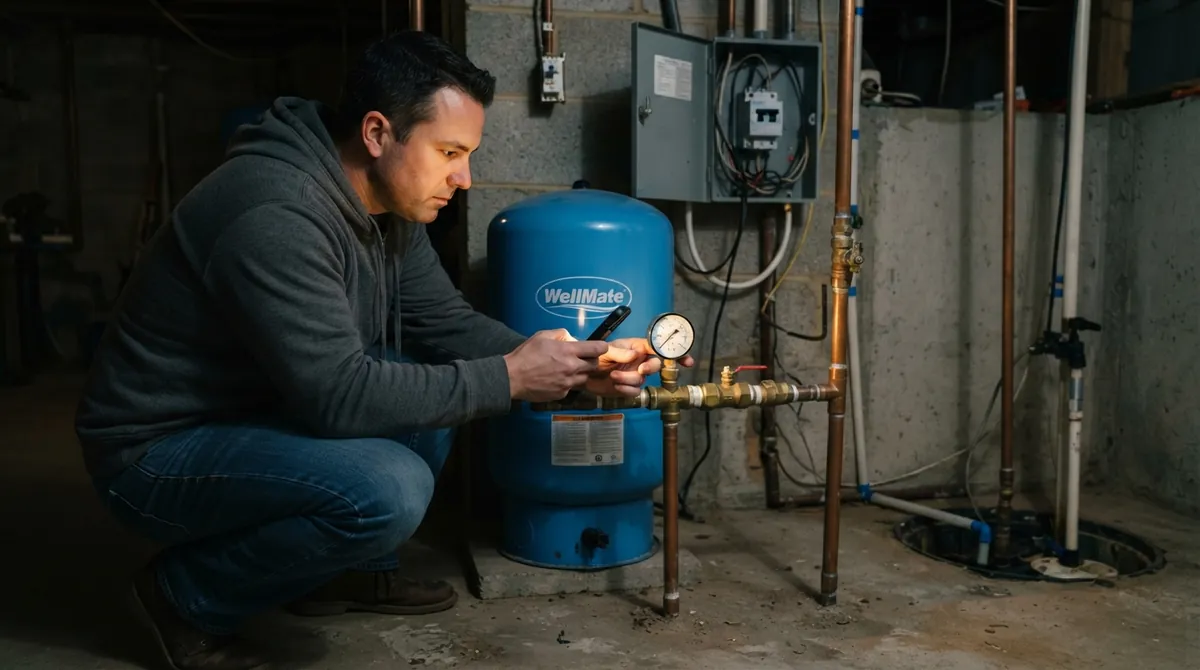
The pressure tank and its fittings
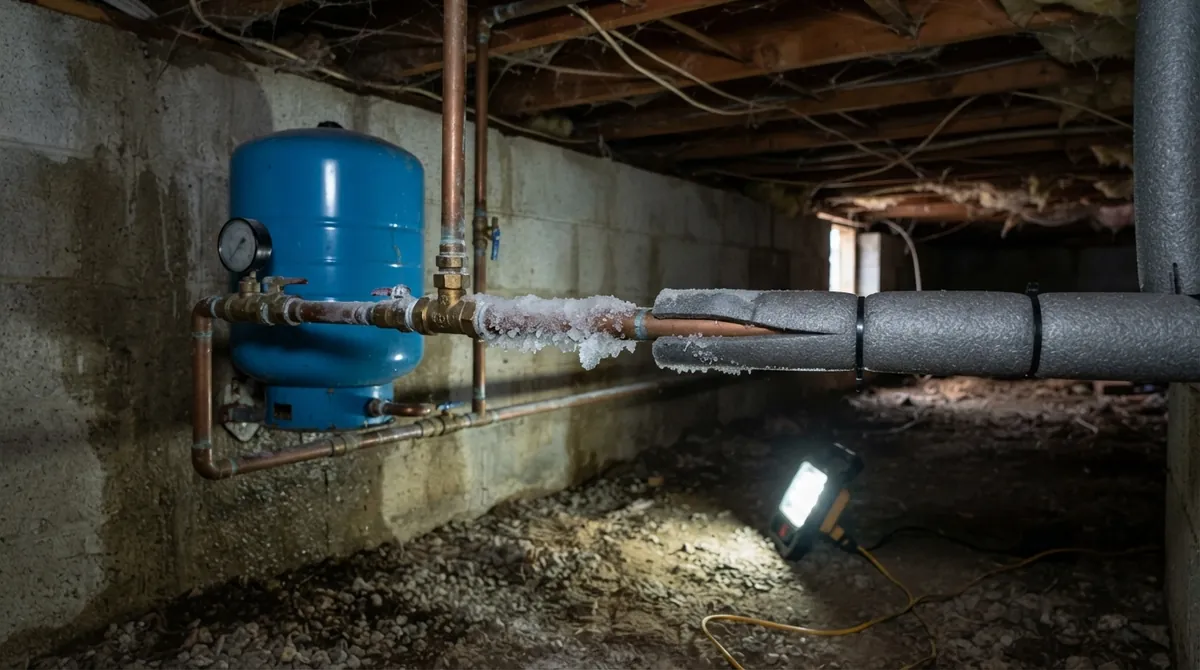
Tanks in unheated crawlspaces, garages and outbuildings freeze at the fittings first — the tee, the drain valve, the gauge. A frozen tank fitting will often crack and then leak only once it thaws, which is why the trouble frequently shows up a day late.
The pressure switch tube
The thin copper or plastic tube connecting the switch to the plumbing holds a tiny amount of water. Freeze that and the switch stops reading pressure correctly — so the pump either will not start or will not stop. It is a common cause of winter behaviour that looks like a failing pressure switch.
Outside spigots and hose bibs
The most common freeze of all, and the least serious — until a split feeds water back into the crawlspace.
A submersible pump does not freeze. It sits in water, well below the frost line, in a well that stays above freezing all year. If you have no water on a cold morning and your pump is submersible, the ice is somewhere between the well head and your taps — not down the well.
If the system is frozen right now
| 1 | Switch the pump off at the breaker. A pump pushing against a solid plug of ice builds pressure with nowhere to send it. That is how pipes split and motors burn. |
| 2 | Open a tap. Leave one open so that meltwater and trapped pressure have somewhere to go as things thaw. |
| 3 | Find the cold section. Follow the line from the well head inward. Frost on the pipe, or a section noticeably colder than the rest, marks the spot. |
| 4 | Warm it slowly. A hair dryer, a heat lamp at a safe distance, warm towels, or a space heater warming the whole space. Start at the end nearest the open tap and work back. |
| 5 | Watch for leaks as it thaws. Splits stay sealed by ice and only announce themselves once the water moves again. Stay with it. |
Never use a torch, a blowtorch or any open flame. Crawlspaces are full of timber, insulation and dust. Beyond the fire risk, direct flame heats one spot fast enough to turn trapped ice to steam, and steam in a sealed pipe bursts it. Every year this turns a frozen pipe into a house fire somewhere.
Why a freeze costs more than the thaw
The ice plug is temporary. Three other things are not.
Split pipe. Water expands as it freezes and the pipe gives way at its weakest point. The split is often small, and often somewhere awkward, and it does not leak until everything thaws.
A pump that ran against it. If the system was left powered, the pump has been trying to push water into a closed pipe. On a submersible that means overheating; on a jet pump it can mean a cracked casing. This is the expensive outcome, and it is the one that switching off at the breaker prevents entirely.
A damaged pressure tank. Water freezing inside a tank can rupture the internal bladder. The tank then behaves exactly like a waterlogged tank — short cycling, poor pressure — but recharging the air will not fix it, because the bladder is gone.
Getting ahead of it before winter
All of this is cheap to prevent and tedious to repair. An hour in October is the whole job.
- Insulate the well head. An insulated well cap cover, or straw bales banked around it. Do not seal the cap itself — the vent must stay clear.
- Lag every exposed pipe. Foam sleeve on anything above ground or running through a crawlspace, including the short vertical run at the well head.
- Use proper heat tape. Self-regulating pipe heating cable, rated for potable water pipe, fitted per the instructions. Check last year’s tape actually still works before you rely on it.
- Insulate the pressure tank and its fittings. The fittings matter more than the tank body. Wrap the tee, the gauge and the switch tube.
- Heat the pump house. A jet pump in an outbuilding needs the space kept above freezing — a thermostatic heater set low does it.
- Close and drain outside spigots. Shut the interior valve, open the spigot, drain it, disconnect hoses. A hose left connected holds water against the bib all winter.
- Seal the crawlspace vents. The cheapest single measure on the list, and the one most often skipped.
Most of these belong on the same visit as the annual maintenance check — the tank pressure and the freeze protection are both autumn jobs, and doing them together saves a trip.
Where we work
Winter well pump callouts across Upstate South Carolina
| ✓Anderson | ✓Greer |
| ✓Taylors | ✓Mauldin |
| ✓Simpsonville | ✓Fountain Inn |
| ✓Travelers Rest | ✓Easley |
What to remember
| 1 | The pump is not what froze. A submersible sits below the frost line. The ice is between the well head and your taps. |
| 2 | Breaker off first. A pump running against ice is how a cheap problem becomes a replacement. |
| 3 | No flame, ever. Gentle heat over a long period. A torch in a crawlspace is a fire, not a repair. |
| 4 | Leaks show up on the thaw. Stay with it while it warms and know where your main shut-off is. |
| 5 | An hour in October settles it. Insulation, heat tape and drained spigots cost almost nothing next to one split pipe. |
Frequently asked questions
Can a well pump actually freeze?
A submersible pump cannot, because it sits in water below the frost line. An above-ground jet pump can, because it holds water and stands in open air. In most cases a frozen well pump turns out to be a frozen pipe, tank fitting or pressure switch tube instead.
How do I know if my well line is frozen rather than the pump failing?
Cold weather and no water at any tap, with the pressure gauge reading normal or high, points at ice. A gauge reading zero points at the pump or its supply instead. The broader checklist is in what to check before you call.
How long does a frozen well line take to thaw?
Anywhere from twenty minutes for an exposed section warmed directly, to most of a day for a buried run you can only warm indirectly. Slow is correct. Forcing it is what splits pipes.
Can I pour hot water on a frozen pipe?
On an accessible metal fitting, warm water is reasonable. On plastic pipe, hot water is not — the temperature difference can crack it. Warm towels give you the same effect with less risk.
Should I leave a tap dripping overnight in a freeze?
Yes, on the coldest nights. Moving water is much harder to freeze. On a well system the trade-off is that a dripping tap eventually cycles the pump, so use one tap rather than several, and only when a hard freeze is actually forecast.
What temperature does a well line freeze at?
Air temperature alone does not decide it. A sheltered, insulated pipe survives nights well below freezing, while an exposed pipe in wind can freeze at temperatures only just below it. Duration and wind matter more than the low reading.
My water came back but now there is a leak. What happened?
The pipe split while frozen and the ice sealed it. As soon as the water moved, the split opened. Shut off the supply and get it repaired before refilling the system.
No water after a cold night?
Switch the breaker off, then call
We trace the frozen section, thaw it without damaging the pipe, and check the tank, switch and pump for damage before putting the system back into service — so a freeze does not quietly turn into a failure in February.
Open 7am–9pm, seven days · No call-out fee with a repair · Fixed price agreed in writing
If the water went off overnight and you are not sure whether it will wait, see no water at night or on a weekend. For how Upstate wells behave through the seasons, see the Upstate well owner’s guide.