
This decision usually gets made badly, and not because anyone is being dishonest. It gets made in a hurry, with no water in the house, on the basis of a single number quoted over the phone.
The framework below is the one worth applying instead. It takes about five minutes and it holds up whoever is doing the work.
The question that decides most cases
Is the fault above the well cap or below it?
Everything above ground — pressure switch, control box, capacitor, wiring, pressure tank — is straightforward access, modest parts, and an hour or two of labour. Repair is almost always right, regardless of the pump’s age. Replacing a pump because the switch failed is a genuine and not uncommon waste of money.
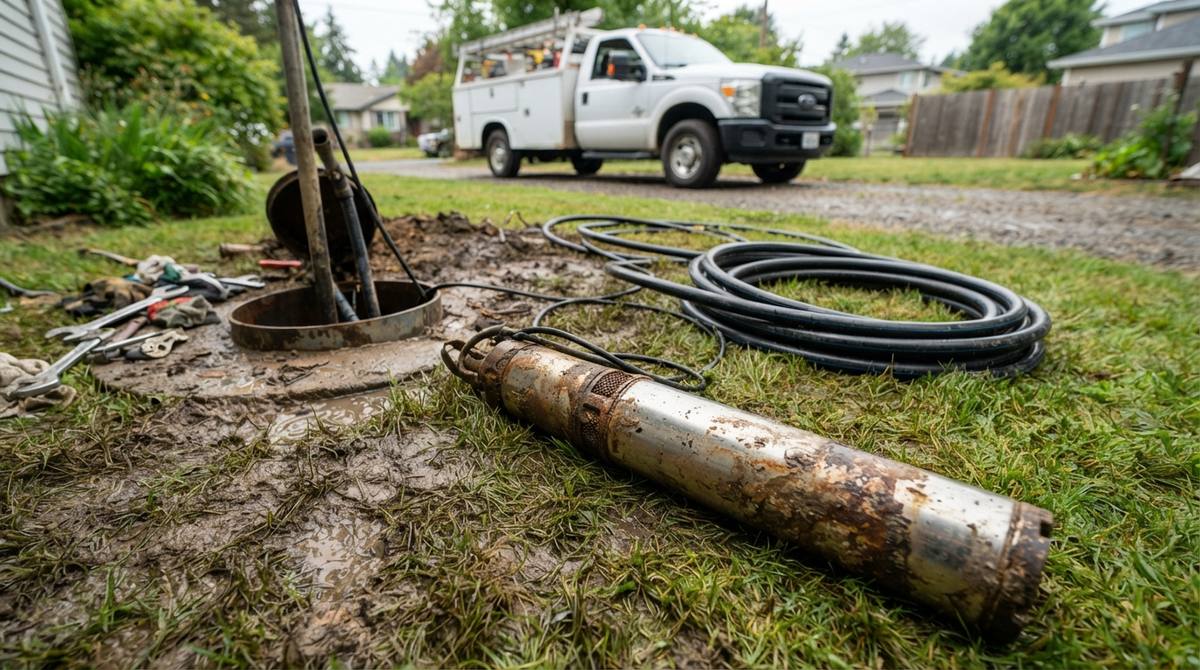
Anything below the cap means pulling the pump: hundreds of feet of pipe and cable, usually a truck and a winch. Most of what you pay for goes into the extraction and reinstallation, not the part itself.
This is the crux of it. If the pump is coming out of the ground anyway, the extra cost of fitting a new one instead of repairing an old one is comparatively small. Repairing a twelve-year-old pump to save part of one bill, and then paying the whole extraction cost again in two years, is the most expensive route available.
The five factors
1. Age
A submersible pump normally lasts eight to fifteen years, a jet pump around ten. Under five years, repair almost always. Over twelve, replace whenever the pump has to be pulled. Between the two, the other factors decide — full context in how long a well pump lasts.
2. Where the fault sits
Above ground, repair. Below ground, weigh it properly. A ground fault in the drop cable is a special case worth naming: it needs the pump pulled, but the pump itself may be perfectly sound, so cable-only replacement can be entirely reasonable on a young pump.
3. What the failure history looks like
One fault in twelve years is bad luck. Three faults in two years is a system telling you something — usually that it was undersized, badly installed, or is running in water that is destroying it. Repeated repairs on the same system are money spent on delaying a conclusion.
4. Water and well conditions
Sand and sediment abrade impellers and shorten pump life regardless of quality. If the water carries grit, a repair without addressing the cause buys less time than the numbers suggest, and the sizing and screening should be looked at as part of the job.
5. Whether the household has changed
Bathrooms added, irrigation installed, more people in the house. A pump that was correctly sized in 2009 may be undersized now, and undersized pumps fail early by running longer and starting more. Replacement here is not just replacement — it is a chance to fix the underlying mismatch.
How it usually plays out
| Pressure switch or capacitor failed | Repair. Above ground, cheap, and unrelated to pump condition at any age. |
| Waterlogged or failed pressure tank | Repair or replace the tank only. Never a reason to replace a pump. See the tank check. |
| Drop cable fault, pump under 8 years | Repair the cable. Ask for the pump to be tested while it is out, then reinstall it. |
| Drop cable fault, pump over 12 years | Replace both. The extraction is already paid for; doing it twice is the expensive outcome. |
| Motor failed or seized | Replace. Rebuilding a residential submersible rarely makes economic sense. |
| Broken drop pipe or check valve | Depends on age. Same logic: the pump is already out, so judge it on its remaining life. Background in running but no water. |
Questions worth asking before you agree
Whoever is quoting, these five questions will tell you quickly whether the recommendation is diagnostic or reflexive.
- What readings led you to this? Amp draw, insulation resistance, voltage at the box. A recommendation with no numbers behind it is a guess.
- Is the fault above ground or below it? If it is above ground, no pump replacement should be on the quote at all.
- How old is the existing pump, and how do you know? Date stamps on the pump or the original install paperwork, not an estimate from the outside of a well cap.
- If it comes out, what is the extra cost to fit new rather than reinstall? This is the only number that answers the repair-or-replace question properly.
- Was the original sizing right for this house today? Fitting the same specification into a house that has grown repeats the fault on a timer.
What a replacement should include
A pump swap on its own is a false economy. Anything already out of the ground and near end of life should come out with it — drop cable, torque arrestor, pitless adaptor seals, and the check valve. Reinstalling twenty-year-old cable alongside a new pump means the next fault brings the whole truck back.
Sizing should be recalculated rather than matched: depth to water, static and drawdown levels, fixture count, and any irrigation demand. And the tank charge should be re-set to the pump’s cut-in afterwards, since the new pump may cut in at a different pressure.
Cost bands for both routes are set out in how much well pump repair costs, and the replacement work itself in well pump replacement.
Where we work
Well pump repair and replacement across Upstate South Carolina
| ✓Anderson | ✓Greer |
| ✓Taylors | ✓Mauldin |
| ✓Simpsonville | ✓Fountain Inn |
| ✓Travelers Rest | ✓Easley |
What to remember
| 1 | Above ground means repair. Switches, capacitors and tanks are never a reason to replace a pump. |
| 2 | If it is coming out, think in years not in one bill. The extraction is the expensive part, and paying it twice is the worst outcome. |
| 3 | Three faults in two years is a system problem. Stop repairing the symptom and look at sizing and water quality. |
| 4 | Ask what readings led to the recommendation. No numbers, no basis for spending money on a new pump. |
| 5 | Replace the cable with the pump. Old cable alongside a new pump is the next callout already booked. |
Frequently asked questions
Should I repair or replace my well pump?
Repair if the fault is above ground, or if the pump is under about eight years old. Replace if the pump has to come out of the well and is past roughly twelve years, or if the same system has failed repeatedly in a short period.
Is it cheaper to repair or replace a well pump?
Repair is cheaper on the day. Over a few years it often is not, because most of the cost of below-ground work is pulling the pump rather than the part itself, and repairing an old pump means paying that extraction cost again sooner.
How do I know how old my well pump is?
From the original installation paperwork, a date stamp on the pump itself once it is out of the well, or the property records if it was installed with the house. An estimate based on the appearance of the well head is not a substitute.
Can a well pump motor be rebuilt?
Industrial pumps are sometimes rebuilt, but for residential submersibles it is rarely worth it. The cost approaches a new pump without matching its life expectancy.
Should I replace the drop cable at the same time?
Yes, if it is anywhere near the age of the pump. The cable is the second most common below-ground failure, and replacing it later means paying to pull the pump all over again.
Does a new pump need a new pressure tank?
Not necessarily, but the tank should be tested at the same visit and its air charge re-set to the new pump’s cut-in pressure. A mismatched tank will shorten the new pump’s life the same way it shortened the old one’s.
My pump keeps failing. Is it a bad pump or a bad well?
Repeated failures usually point at the system rather than the part — undersizing for current household demand, sand in the water, or a pump set at the wrong depth for how far the well draws down in summer. That question is worth answering before buying another pump.
Been told you need a new pump?
Get the readings before you decide
We diagnose first and quote both routes where both are genuinely available — what a repair buys you, what a replacement buys you, and the honest expected life of each. Fixed price agreed in writing before any work starts.
Open 7am–9pm, seven days · No call-out fee with a repair · Fixed price agreed in writing
See what each route involves under well pump replacement and well pump repair. If you are without water right now, start at emergency well pump repair instead.