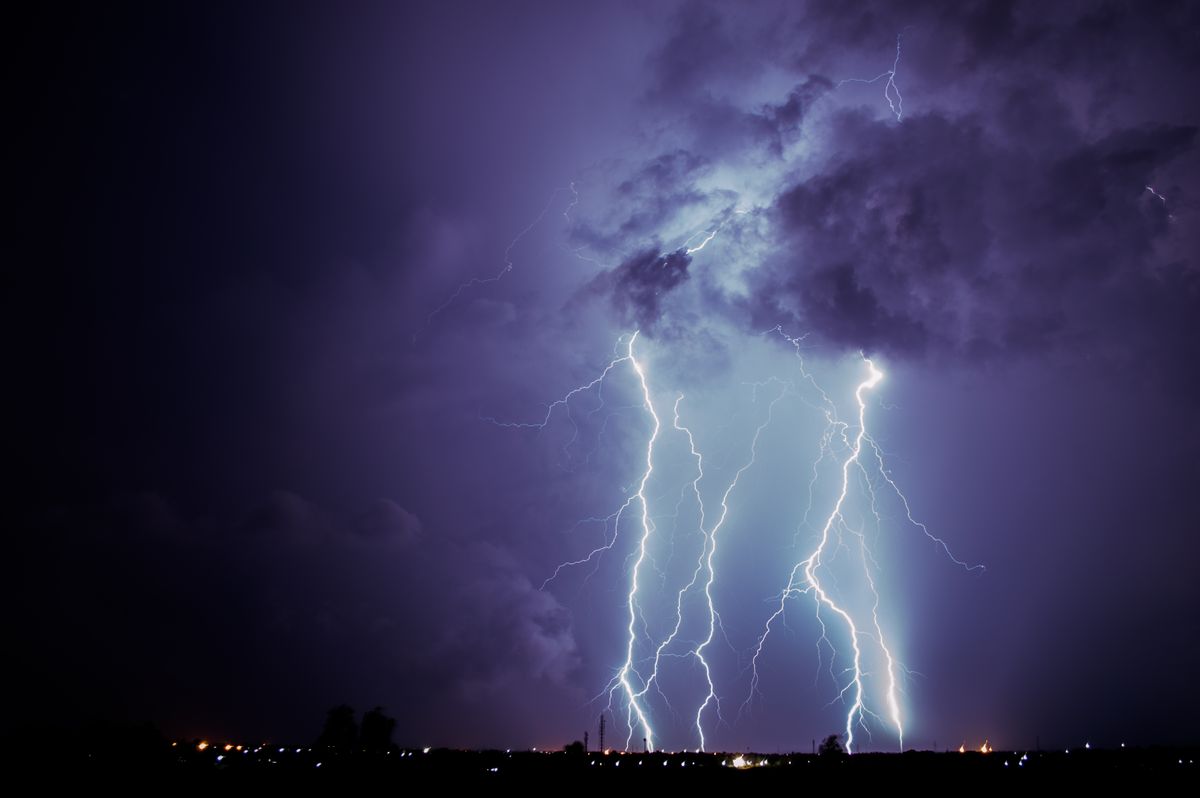

Summer thunderstorms roll across the Upstate most afternoons from June into September, and every season brings the same run of calls: the storm passed, the power flickered or did not, and afterwards the well is silent. Sometimes the only evidence is a faint burnt smell at the control box.
How lightning reaches a well pump
A submersible pump sits hundreds of feet down in water, connected to the surface by a steel casing, a metal or plastic drop pipe, and a long electrical cable. That combination gives a surge several ways in.
| Ground strike nearby | Current spreading through the ground finds the well casing and water column, a good path down. It jumps to the motor or cable on the way. |
| Strike on power lines | A surge travels in through the electrical service and reaches everything connected, the pump circuit included. |
| Direct strike on or near the wellhead | Less common, and often more destructive. Can damage everything from the wellhead down. |
| Utility switching after the storm | Not lightning itself, but the spike when power is restored can finish off components already weakened. |
What usually fails, most common first
- Control box on three-wire submersibles. Capacitors and relays are sensitive to surges. See control box symptoms.
- Pressure switch. Contacts can weld closed or burn open.
- Breaker. Sometimes trips; occasionally damaged itself.
- Submersible cable insulation. A surge can puncture it, causing a ground fault down the well.
- Motor windings. The pump itself, and the most expensive outcome.
Two-wire submersibles have their starting components inside the motor, so a surge that would take out a control box on a three-wire system goes straight to the pump instead. That is one reason the same storm leaves some neighbours with a cheap fix and others with a pump pull.
Signs of lightning damage
- No water immediately after a storm, with the breaker on
- A breaker that trips as soon as you reset it
- A pump that hums but does not start
- Scorch marks, melted plastic or a burnt smell at the switch or control box
- Other damaged electronics in the house from the same storm — garage door opener, modem, TV
If you see or smell burning, switch the pump breaker off and leave it off. Do not keep resetting a breaker after a strike. A damaged motor or cable can be pushed from repairable to ruined by repeated attempts to start it.
Diagnosing it properly
A proper lightning diagnosis works from the top down. The switch and control box are tested first, because they are the most likely failures and the cheapest to replace. Then, from the surface, the motor windings and cable insulation are tested with a meter — which tells you whether anything down the well has been damaged without pulling it.
One trap is worth knowing. A strike can take out the control box and weaken the cable insulation at the same time. Replacing the box gets the pump running, and the weakened cable fails a few weeks later. Testing the insulation during the first visit catches that.
Homeowner’s insurance
Many homeowner’s policies cover sudden damage caused by lightning, and a well pump is part of the house’s systems. Policies vary, so check yours — but if you plan to claim, the paperwork matters.
- Note the date and time of the storm and when you first lost water.
- Photograph any visible damage before anything is replaced.
- Keep the failed parts if the insurer may want them.
- Ask for a written diagnosis that states the cause, the readings, and what was replaced.
We provide written findings on request for exactly this reason.
Protecting the pump from the next one
Nothing makes a well fully lightning-proof, but the odds can be improved a great deal.
- A lightning arrestor on the pump circuit. Mounted at the pressure switch or control box and properly grounded, it gives a surge a path to earth before it reaches the motor.
- Correct grounding. The pump motor’s ground conductor should be connected at the surface. On older installations it sometimes is not.
- A whole-house surge protector at the main panel, installed by an electrician, to deal with surges arriving on the power lines.
- Turning the pump off during a severe storm if you are home and have water in the tank. Simple and effective.
Where we work
Storm damage repair across Upstate South Carolina
| ✓Anderson | ✓Greer |
| ✓Taylors | ✓Mauldin |
| ✓Simpsonville | ✓Fountain Inn |
| ✓Travelers Rest | ✓Easley |
What to remember
| 1 | It does not need a direct hit. Nearby ground strikes and line surges do the damage. |
| 2 | Surface parts fail first. Control box and switch before the pump. |
| 3 | Test the cable too. A weakened insulation fails weeks later. |
| 4 | Document it for insurance. Photos, parts and a written diagnosis. |
| 5 | An arrestor is cheap protection. Properly grounded, it is worth fitting. |
Frequently asked questions
Can lightning damage a well pump?
Yes. A strike nearby can send a surge through the ground, the well casing or the power supply. It commonly damages the control box and pressure switch, and can damage the pump motor or the cable running down the well.
How do I know if lightning hit my well pump?
Loss of water during or just after a storm, a breaker that trips immediately on reset, a pump that hums without starting, or burn marks or a burnt smell at the switch or control box. Other electronics failing in the same storm is another clue.
Does homeowner’s insurance cover a well pump damaged by lightning?
Many policies cover sudden lightning damage, but coverage varies. Check your policy, photograph the damage, keep the failed parts and ask your technician for a written diagnosis.
Will a surge protector protect my well pump?
A lightning arrestor on the pump circuit, correctly grounded, and a whole-house surge protector at the main panel both reduce the risk substantially. Neither makes a well completely lightning-proof.
Should I turn my well pump off during a thunderstorm?
If you are home and there is water in the pressure tank, switching the pump breaker off during a severe storm is a simple way to reduce the risk. Remember to switch it back on afterwards.
Is my pump ruined if lightning struck near the well?
Not necessarily. The control box and switch often take the damage while the pump survives. A surface test of the motor windings and cable insulation shows whether anything down the well was affected.
Why did my neighbour’s pump survive the same storm?
Distance from the strike, grounding, surge protection and pump type all matter. A three-wire system may lose only its control box, while a two-wire pump takes the surge directly in the motor.
Lost water after a storm?
Find out what the strike actually damaged
We test from the top down — switch, control box, then motor and cable from the surface — and give you written findings for your insurer if you need them, with a fixed price agreed before any work starts.
Open 7am–9pm, seven days · No call-out fee with a repair · Fixed price agreed in writing
See emergency well pump repair, and what to check after a power outage if the storm also cut the power.