
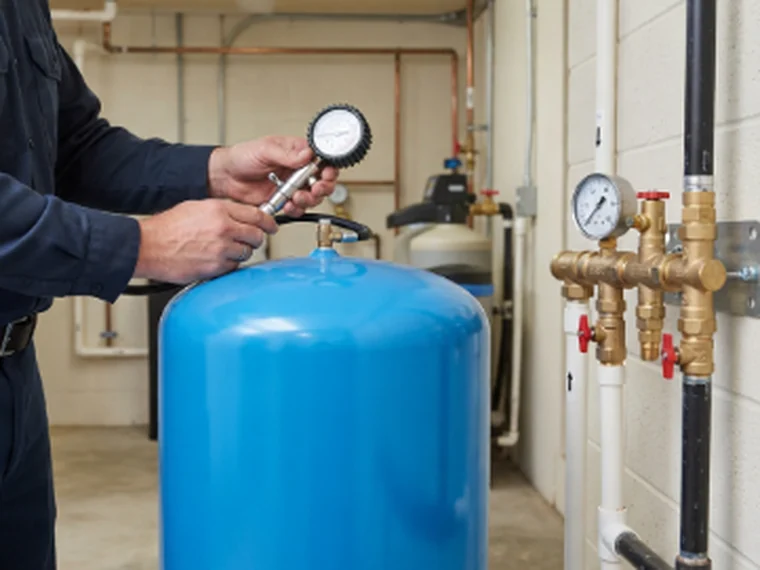
Why it matters
A Failed Tank Is What Kills the Pump
The pressure tank does one job: it holds a cushion of compressed air so your pump can rest between draws. When the bladder fails or the air charge is lost, that cushion disappears. The pump then starts and stops every few seconds instead of running in proper cycles.
That is called short cycling, and it is the single fastest way to destroy a well pump motor. A tank costs a fraction of a pump, which is why we check it on every callout.
- Pump clicks on and off constantly — the clearest sign the tank has waterlogged.
- Pressure surges then drops while a tap runs — no air cushion left to hold steady pressure.
- The tank feels full and heavy all over — a healthy tank sounds hollow near the top.
- Water spits from the air valve — the bladder has ruptured and needs replacing.
- Rising power bill with no change in usage — the pump is restarting far more often than it should.
Left alone, a waterlogged tank will take the pump with it. Caught early, it is a straightforward job. If yours is already showing these signs, see well pump repair for what a full system test covers.
What Our Pressure Tank Service Covers
Whether the tank can be recharged or needs replacing depends on what actually failed. We test before deciding, because a tank that only lost its air charge does not need to be thrown away.
Test the air charge
Pressure read at the air valve with the system drained, then compared against the pump’s cut-in setting. This alone identifies most tank faults.
Recharge or replace
An intact tank that lost pressure gets recharged and rechecked. A ruptured bladder means the tank is finished and we quote a replacement.
Match the switch settings
Air charge set just below cut-in pressure, then flow and pressure re-tested at the tap so the pump cycles properly again.
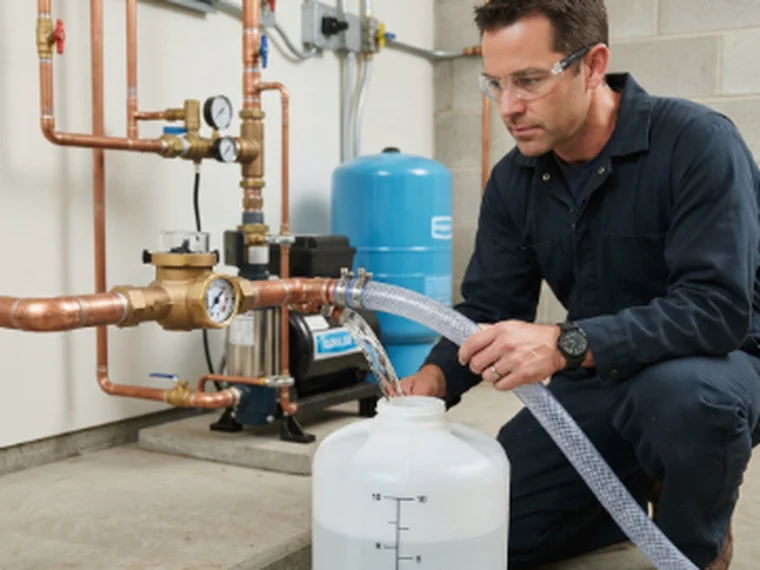
Sizing
Getting the Tank Size Right
An undersized tank is the reason plenty of replacement tanks fail early. The tank has to give the pump a long enough run time on each cycle, and that depends on the pump’s flow rate, not on what fits the space.
- Drawdown, not total volume — what matters is how much water the tank actually delivers between cut-in and cut-out, which is far less than its stated size.
- Matched to pump flow rate — a higher output pump needs a bigger tank to get the same run time.
- Household demand — more bathrooms and appliances means more frequent draws and a stronger case for going up a size.
- Switch settings checked together — tank and pressure switch have to be set as a pair, or the new tank waterlogs again.